 KSCP
 APFCP
 SIUCP-ETS
 NSCRD
 SCRS


Visual abstracts
- Page Path
- HOME > Browse Articles > Visual abstracts
Original Articles
Benign proctology,Surgical technique
- Injection of aluminum potassium sulfate and tannic acid in the treatment of fecal incontinence: a single-center observational study
- Tatsuya Abe, Masao Kunimoto, Yoshikazu Hachiro, Kei Ohara, Mitsuhiro Inagaki
- Ann Coloproctol. 2022;38(6):403-408. Published online July 21, 2021
- DOI: https://doi.org/10.3393/ac.2021.00248.0035

- 10,490 View
- 174 Download
- 4 Web of Science
- 5 Citations
-
 Graphical Abstract
 Abstract
 PDF
- Purpose
Perianal injection of bulking agents is an attractive treatment option for patients with mild to moderate fecal incontinence (FI). Various bulking agents have been used for injection therapy, but the optimal injection materials and methods are yet to be standardized. This study aimed to evaluate the effects of injection therapy using aluminum potassium sulfate and tannic acid (ALTA) in the management of FI.
Methods
This study included consecutive patients who underwent ALTA injection therapy for FI at our institution. The procedure was performed with the patient in the jackknife position, under caudal epidural anesthesia. The procedure consisted of a 4-step injection to the 3 main cushions and a multipoint injection to the remaining submucosa of the anal canal.
Results
Seventy-seven patients (mean age, 76 years) were enrolled in the study. The mean Cleveland Clinic incontinence score of 11.9 ± 4.1 at baseline significantly improved to 7.3 ± 5.2 at 3 months following treatment. The mean maximal resting pressure also increased significantly 3 months after the intervention. Postoperative complications were observed in 3 patients (3.9%), and all events were mild. The mean duration of postoperative follow-up was 17.5 months. The cumulative recurrence-free rate at 3 years was 72.4%.
Conclusion
ALTA injection for FI is safe, easy to perform, and provides reasonable mid-term outcomes. Moreover, concomitant anorectal diseases that may be contraindicated by other injectable bulking agents could be treated simultaneously. Therefore, ALTA injection is a promising alternative in the absence of other injectable agents. -
Citations
Citations to this article as recorded by
- Comparative study of one-step and four-step injection combined with external stripping and internal ligation for mixed hemorrhoids
Shu-Han Li, Xian-Shu Wu, Lun Zhao, Xue-Feng Liu, Wei-Ru Lan, Wan-Ni Sun, Na Zhao, Yue-Dong Liu
World Journal of Gastrointestinal Surgery.2026;[Epub] CrossRef - Effective non-surgical treatment of hemorrhoids with sclerosing foam and novel injection device
Juan Cabrera Garrido, Gonzalo López González
Gastroenterology & Endoscopy.2024; 2(4): 176. CrossRef - Tissue engineering and regenerative medicine approaches in colorectal surgery
Bigyan B. Mainali, James J. Yoo, Mitchell R. Ladd
Annals of Coloproctology.2024; 40(4): 336. CrossRef - Efficacy and Safety of a New Technique Combining Injection Sclerotherapy and External Hemorrhoidectomy for Prolapsed Hemorrhoids: A Single-center Observational Study
Tatsuya Abe, Masao Kunimoto, Yoshikazu Hachiro, Akane Ito, Kenji Watanabe, Shigenori Ota, Kei Ohara, Mitsuhiro Inagaki, Yusuke Saitoh, Masanori Murakami
Journal of the Anus, Rectum and Colon.2024; 8(4): 331. CrossRef - Simple Anal Reinforcement with Anal Encirclement Using an Artificial Ligament in Patients with fecal Incontinence: A Single-center Observational Study
Tatsuya Abe, Masao Kunimoto, Yoshikazu Hachiro, Shigenori Ota, Kei Ohara, Mitsuhiro Inagaki
Journal of the Anus, Rectum and Colon.2022; 6(3): 174. CrossRef
- Comparative study of one-step and four-step injection combined with external stripping and internal ligation for mixed hemorrhoids
Minimally invasive surgery,Surgical technique
- The impact of assistants’ reverse alignment surgical skill proficiency on laparoscopic colorectal surgery
- Seunghun Lee
- Ann Coloproctol. 2022;38(6):432-441. Published online January 20, 2022
- DOI: https://doi.org/10.3393/ac.2021.00689.0098

- 6,726 View
- 153 Download
- 4 Web of Science
- 4 Citations
-
Graphical Abstract
Abstract
PDF
- Purpose
We aimed to investigate the difference in the surgical outcome based on whether the assistant overcame the mirror image in laparoscopic colorectal surgery.
Methods
Three hundred patients who underwent laparoscopic colorectal surgery performed by single operator were divided into 2 groups. Based on the assistants’ experience, patients who underwent surgery involving 1 of 6 residents with an experience of fewer than 30 surgeries each were classified into group 1. Patients who underwent surgery involving a single fellow as an assistant with an experience of over 1,000 surgeries were classified into group 2. According to the type of surgery, patients were divided into left and right colon resection groups and the surgical outcome of groups 1 and 2 was investigated.
Results
Group 2 exhibited shorter operation time, less bleeding, shorter postoperative hospital stay, lower open conversion, and anastomotic leakage rate than group 1. In right colon resection, the operation time was shorter in group 2. In left colon resection, group 2 exhibited shorter operation time, less bleeding, shorter postoperative hospital stay, and lower anastomotic leakage rate. In the multivariate analysis, the assistant was a factor affecting the operation time in the entire surgery.
Conclusion
Assistants’ reverse alignment surgical skill proficiency was a factor affecting the operation time. -
Citations
Citations to this article as recorded by- The Impact of the First Assistant's Experience on the Perioperative Outcome of Patients Undergoing Laparoscopic Hysterectomies for Benign Diseases: A Retrospective Analysis
Sangam Jha, Vikas Chandra Jha, Sharda Jha, Jafeesha B. Singh
Journal of Gynecologic Surgery.2025; 41(4): 164. CrossRef - Design of Automatic Tool Replacement Mechanism for Laparoscopic Surgical Robot Arm for Solo Surgery
Daehwan Ko, Yeonkyoung Kim, Hongseok Lim, Sungmin Kim
The International Journal of Medical Robotics and Computer Assisted Surgery.2025;[Epub] CrossRef - Sex Disparities in Rectal Cancer Surgery: An In-Depth Analysis of Surgical Approaches and Outcomes
Chungyeop Lee, In Ja Park
The World Journal of Men's Health.2024; 42(2): 304. CrossRef - Can assistants’ skills be used to improve colorectal cancer surgery outcomes in a way similar to the “butterfly effect”?
Je-Ho Jang
Annals of Coloproctology.2022; 38(6): 391. CrossRef
- The Impact of the First Assistant's Experience on the Perioperative Outcome of Patients Undergoing Laparoscopic Hysterectomies for Benign Diseases: A Retrospective Analysis
Malignant disease,Epidemiology & etiology
- Colorectal cancer mortality trends in the era of cancer survivorship in Korea: 2000–2020
- Min Hyun Kim, Sanghee Park, Nari Yi, Bobae Kang, In Ja Park
- Ann Coloproctol. 2022;38(5):343-352. Published online October 28, 2022
- DOI: https://doi.org/10.3393/ac.2022.00535.0076
- 17,807 View
- 214 Download
- 31 Web of Science
- 30 Citations
-
Graphical Abstract
Abstract
PDF
 Supplementary Material
- Purpose
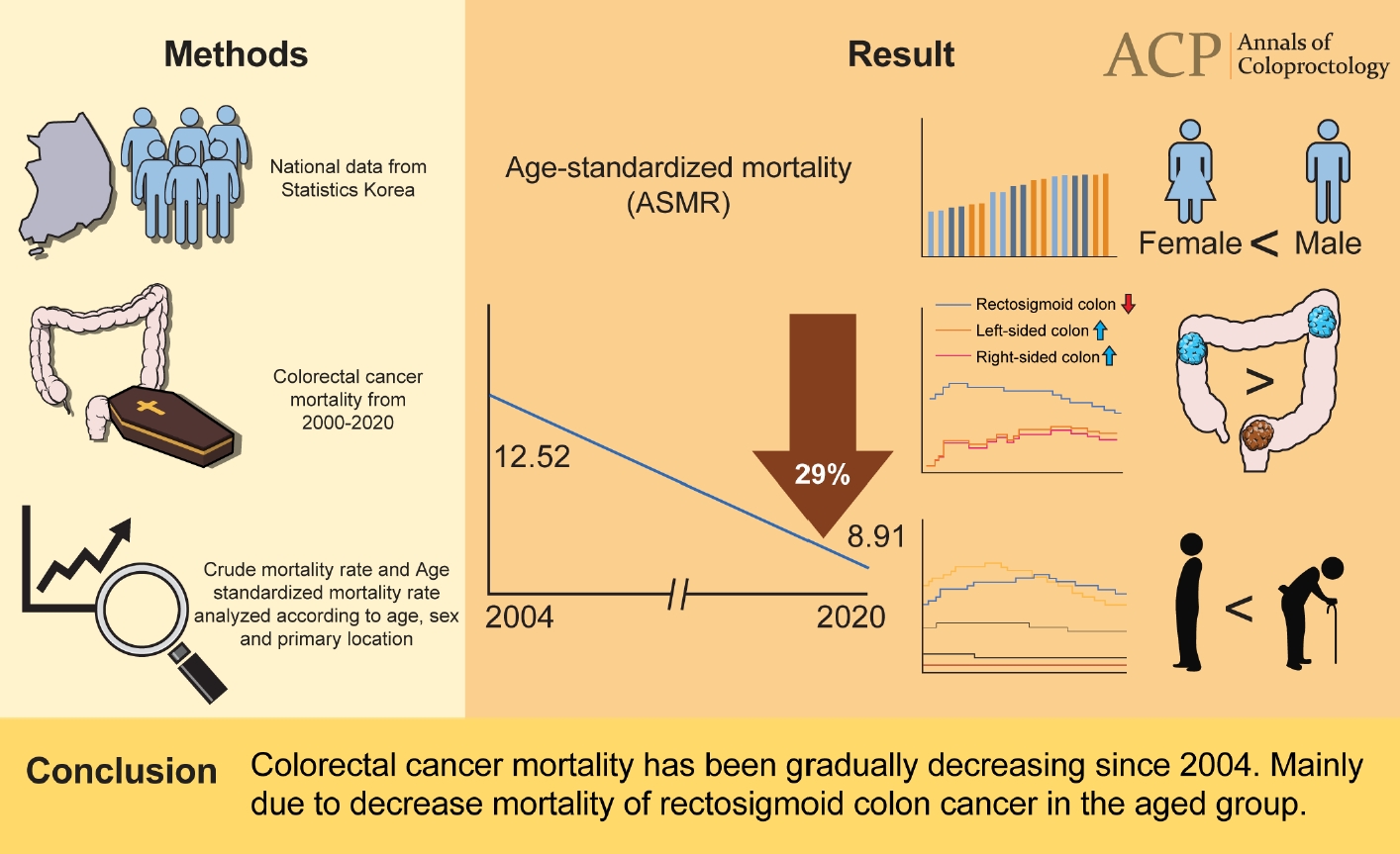
Korea has implemented an early screening for colorectal cancer since 2004. However, it is not known whether this has translated into improved survival over the years.
Methods
We acquired colorectal cancer mortality data from the Cause of Death Statistics in Korea from 2000 to 2020. We characterized the data into year of death, cancer-specific loci, and age group. We analyzed age-standardized mortality rates (ASMR) according to year of death, age group, and primary location to find trends in colorectal cancer mortality over a 20-year period.
Results
The crude mortality rate of colorectal cancer increased from 8.78 per 100,000 in 2000 to 17.27 per 100,000 in 2020. The second decade was slower in increments compared to the first decade. ASMR showed a decrease over the second decade after an initial increase in the first decade. The decrease was primarily from the lowering of ASMR for rectosigmoid cancers. Age group analysis showed a lowering of ASMR mainly in the 45–59-year, 60–74-year, and ≥ 75-year age groups; however, 0–29-year and 30–44-year age groups showed generally unchanged ASMR over the total period.
Conclusion
After a brief incline of age-specific mortality of colorectal cancers during the early 2000s, colorectal cancer mortality has gradually been decreasing in the past decade. This was mainly due to decreased mortalities in rectosigmoid colon cancers especially in the age groups that were the target of early screening. -
Citations
Citations to this article as recorded by- Clinical profile, treatment patterns, and early outcomes of colorectal cancer at Kassala Police Hospital, Eastern Sudan: a 10-year retrospective cohort study
Abdel Latif Khalifa Elnaim, Salma Salah Hassan Mohamed Ali, Rawah Suliman Mohamed Ahmed, Ismail Sagap
Scientific Reports.2026;[Epub] CrossRef - Predominance of Peritoneal Metastasis in the Recurrence Pattern of T4 Colorectal Cancer: A Retrospective Cohort Study
Jin Gi Chang, In Ja Park, Young Il Kim, Jong Lyul Lee, Yong Sik Yoon, Chan Wook Kim, Seok-Byung Lim
Annals of Surgical Oncology.2026; 33(10): 9186. CrossRef - Gochujang attenuates colorectal cancer by promoting colonic SCFA utilization and GPCR expression despite limited recovery of microbial diversity
Jin Young Baek, Ji-Woo Kim, Do-Youn Jeong, Seungyong Hwang, Dallas R. Donohoe, Anna Han
Journal of Functional Foods.2026; 143: 107417. CrossRef - Translational Validation of a Novel Multi-Locus ctDNA Methylation Assay for Early Detection and Stratification of Colorectal Cancer: An Exploratory Prospective, Case-Control Study
Hayoung Lee, Jae Cheol Kang, In Ja Park, Gwang-un Kim, Hwi Hyun, Na Young Min, Sungwon Jeon, Byoung-Chul Kim
International Journal of Molecular Sciences.2026; 27(13): 5738. CrossRef - Controversies in the emergency management of colorectal cancer and strategies for improved outcomes: a systematic review
ALK Elnaim, MPK Wong, I Sagap
South African Journal of Surgery.2026; 64(2): 125. CrossRef - Association between relative dose intensity of adjuvant chemotherapy and survival outcomes in patients aged ≥ 70 years with high-risk stage II and stage III colon cancer
Chaninart Liengudom, Chutima Upachar, Achaporn Vichitranusa, Sorrapong Manyanont
Journal of Geriatric Oncology.2026; 17(7): 103066. CrossRef - Immunological changes and recovery-related factors in older patients with colon cancer: A pilot trial
Byeo Lee Lim, Young Il Kim, Jong Lyul Lee, Chan Wook Kim, Yong Sik Yoon, Yousun Ko, Kyung Won Kim, In Ja Park
Journal of Geriatric Oncology.2025; 16(3): 102200. CrossRef - Oncologic outcomes of surgically treated colorectal cancer in octogenarians: a comparative study using inverse probability of treatment weighting (IPTW)
Soo Young Oh, Jung Yun Park, Kwan Mo Yang, Seong-A Jeong, Yong Jae Kwon, Yun Tae Jung, Chung Hyeun Ma, Keong Won Yun, Kwang Hyun Yoon, Jae Young Kwak, Chang Sik Yu
BMC Gastroenterology.2025;[Epub] CrossRef - Oncologic outcomes and associated factors of colon cancer patients aged 70 years and older
Byeo Lee Lim, In Ja Park, Jun-Soo Ro, Young Il Kim, Seok-Byung Lim, Chang Sik Yu
Annals of Coloproctology.2025; 41(3): 198. CrossRef - Older Age Threshold for Oxaliplatin Benefit in Stage II to III Colorectal Cancer
Jun Woo Bong, Hwamin Lee, Seogsong Jeong, Sanghee Kang
JAMA Network Open.2025; 8(8): e2525660. CrossRef - Primary tumor resection vs. self-expandable metallic stent in unresectable obstructive stage IV colorectal cancer: a comparative outcome study
Chang Hyun Kim, Jae Kyun Ju, Jaram Lee, Hyeung-min Park, Soo Young Lee, Hyeong Rok Kim, Young Eun Joo, Sung Bum Cho
Annals of Surgical Treatment and Research.2025; 109(2): 89. CrossRef - Evaluation of the utility of a nomogram for predicting lymph node metastasis in T1 colorectal cancer in shared decision-making in clinical practice: a survey-based study
Hyeon Seung Kim, Kyung Su Han, Min Wan Lee, Dae Kyung Sohn, Chang Won Hong, Dong Woon Lee, Kiho You, Sung Chan Park, Byung Chang Kim, Bun Kim, Jae Hwan Oh
Annals of Coloproctology.2025; 41(4): 303. CrossRef - Oncologic outcomes of multivisceral resection for locally advanced colorectal cancer: a single-center retrospective cohort study
Jaram Lee, Hyeung-min Park, Soo Young Lee, Chang Hyun Kim, Hyeong Rok Kim
BMC Surgery.2025;[Epub] CrossRef - Performance reporting design in artificial intelligence studies using image-based TNM staging and prognostic parameters in rectal cancer: a systematic review
Minsung Kim, Taeyong Park, Bo Young Oh, Min Jeong Kim, Bum-Joo Cho, Il Tae Son
Annals of Coloproctology.2024; 40(1): 13. CrossRef - Sex Disparities in Rectal Cancer Surgery: An In-Depth Analysis of Surgical Approaches and Outcomes
Chungyeop Lee, In Ja Park
The World Journal of Men's Health.2024; 42(2): 304. CrossRef - In-Hospital Mortality and Associated Factors among Colorectal Cancer Patients in Germany
Karel Kostev, Sarah Krieg, Andreas Krieg, Tom Luedde, Sven H. Loosen, Christoph Roderburg
Cancers.2024; 16(6): 1219. CrossRef - Effect of Fluorescence Lymph Node Mapping on Improving Diagnostic Values of CT D3 Lymph Node Staging for Right-Sided Colon Cancer
Gyung Mo Son, Tae Un Kim, Mi Sook Yun, ChangYeop Kim, In Young Lee, Su Bum Park, Dong-Hoon Shin, Gi Won Ha
Cancers.2024; 16(20): 3496. CrossRef -
Gochujang suppresses cell survival and changes reactive oxygen species metabolism in colorectal cancer cells
Eun-Bi Seo, So-Min Oh, Anna Han
Food & Nutrition Research.2024;[Epub] CrossRef - Optimal Indocyanine Green Dosage for Repetitive Angiography for Laparoscopic Colorectal Surgery
Gyung Mo Son, Sang-Ho Park, Nam Su Kim, Mi Sook Yun, In Young Lee, Myeong-Sook Kwon, Tae Kyun Kim, Eun Hwa Lee, Eun Jung Hwang, Kwang-Ryul Baek
Medicina.2024; 60(12): 1966. CrossRef - Beyond survival: a comprehensive review of quality of life in rectal cancer patients
Won Beom Jung
Annals of Coloproctology.2024; 40(6): 527. CrossRef - Clinical implication of tissue carcinoembryonic antigen expression in association with serum carcinoembryonic antigen in colorectal cancer
Abdulmohsin Fawzi Aldilaijan, Young Il Kim, Chan Wook Kim, Yong Sik Yoon, In Ja Park, Seok-Byung Lim, Jihun Kim, Jun-Soo Ro, Jin Cheon Kim
Scientific Reports.2023;[Epub] CrossRef - Development and validation of nomogram models to predict radiotherapy or chemotherapy benefit in stage III/IV gastric adenocarcinoma with surgery
Xiangqing Ren, Tian Huang, Xiaolong Tang, Qian Ma, Ya Zheng, Zenan Hu, Yuping Wang, Yongning Zhou
Frontiers in Oncology.2023;[Epub] CrossRef - Prognostic prediction of colorectal cancer using the C-reactive protein to albumin ratio: the importance of inflammatory biomarkers and their association with long-term outcomes
Chul Seung Lee
Annals of Coloproctology.2023; 39(4): 287. CrossRef - Unveiling the profound advantages of total neoadjuvant therapy in rectal cancer: a trailblazing exploration
Kyung Uk Jung, Hyung Ook Kim, Hungdai Kim, Donghyoun Lee, Chinock Cheong
Annals of Surgical Treatment and Research.2023; 105(6): 341. CrossRef - National cancer screening program for colorectal cancer in Korea
Seung Min Baik, Ryung-Ah Lee
Annals of Surgical Treatment and Research.2023; 105(6): 333. CrossRef - Recurrence Patterns and Risk Factors after Curative Resection for Colorectal Cancer: Insights for Postoperative Surveillance Strategies
Hyo Seon Ryu, Jin Kim, Ye Ryung Park, Eun Hae Cho, Jeong Min Choo, Ji-Seon Kim, Se-Jin Baek, Jung-Myun Kwak
Cancers.2023; 15(24): 5791. CrossRef - Influence of the COVID-19 Pandemic on the Treatment Patterns and Outcomes of Colorectal Cancer
In Ja Park
The Ewha Medical Journal.2023;[Epub] CrossRef - How Can We Improve the Tumor Response to Preoperative Chemoradiotherapy for Locally Advanced Rectal Cancer?
Jeonghee Han
The Ewha Medical Journal.2023;[Epub] CrossRef - Inflammatory Response Markers as Predictors of Colorectal Cancer Prognosis
Minsung Kim, Il Tae Son, Bo Young Oh
The Ewha Medical Journal.2023;[Epub] CrossRef - Preventing Anastomotic Leakage, a Devastating Complication of Colorectal Surgery
Hyun Gu Lee
The Ewha Medical Journal.2023;[Epub] CrossRef
- Clinical profile, treatment patterns, and early outcomes of colorectal cancer at Kassala Police Hospital, Eastern Sudan: a 10-year retrospective cohort study
Malignant disease,Rectal cancer,Complication,Biomarker & risk factor
- Cross-sectional area of psoas muscle as a predictive marker of anastomotic failure in male rectal cancer patients: Japanese single institutional retrospective observational study
- Yusuke Mizuuchi, Yoshitaka Tanabe, Masafumi Sada, Koji Tamura, Kinuko Nagayoshi, Shuntaro Nagai, Yusuke Watanabe, Sadafumi Tamiya, Kohei Nakata, Kenoki Ohuchida, Toru Nakano, Masafumi Nakamura
- Ann Coloproctol. 2022;38(5):353-361. Published online April 12, 2022
- DOI: https://doi.org/10.3393/ac.2022.00122.0017
- 9,418 View
- 187 Download
- 10 Web of Science
- 11 Citations
-
Graphical Abstract
Abstract
PDFSupplementary Material
- Purpose
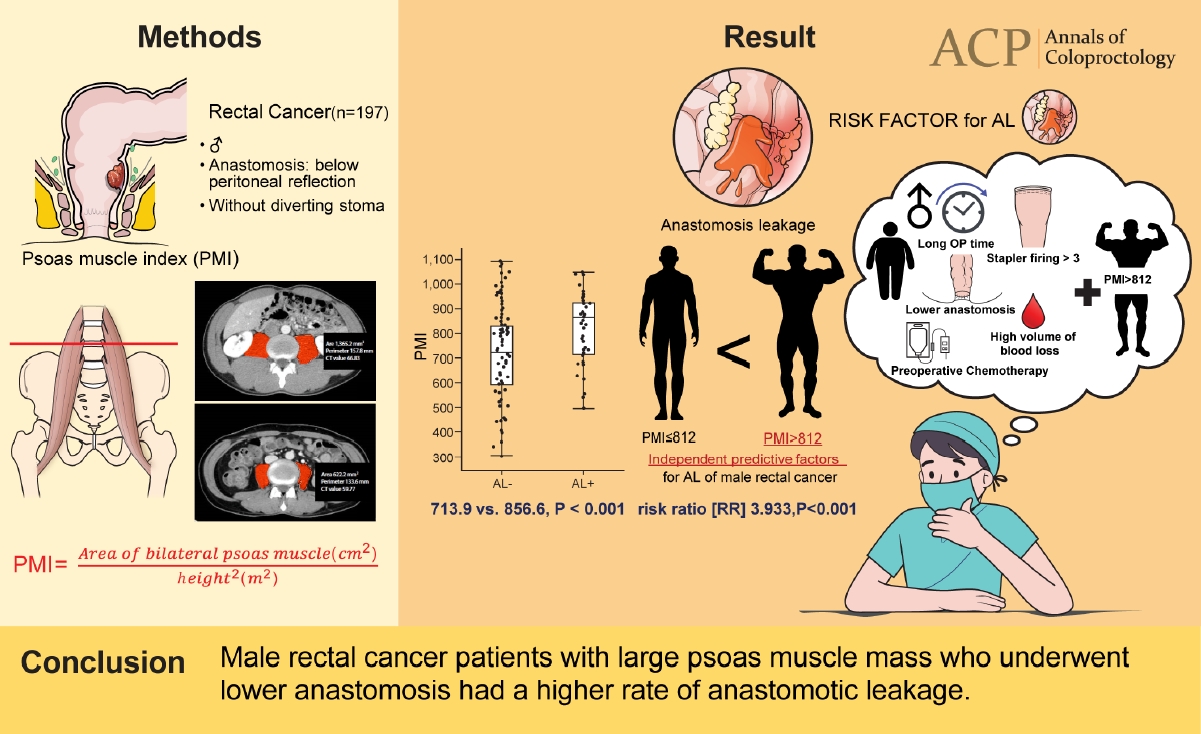
Preoperative sarcopenia worsens postoperative outcomes in various cancer types including colorectal cancer. However, we often experienced postoperative anastomotic leakage in muscular male patients such as Judo players, especially in rectal cancer surgery with lower anastomosis. It is controversial whether the whole skeletal muscle mass impacts the potential for anastomotic failure in male rectal cancer patients. Thus, the purpose of this study was to clarify whether skeletal muscle mass impacts anastomotic leakage in rectal cancer in men.
Methods
We reviewed the medical charts of male patients suffering from rectal cancer who underwent colo-procto anastomosis below the peritoneal reflection without a protective diverting stoma. We measured the psoas muscle area and calculated the psoas muscle index.
Results
One hundred ninety-seven male rectal cancer patients were enrolled in this study. The psoas muscle index was significantly higher in patients with anastomotic leakage (P<0.001). Receiver operating characteristic curve determined the optimal cut-off value of the psoas muscle index for predicting anastomotic leakage as 812.67 cm2/m2 (sensitivity of 60% and specificity of 74.3%). Multivariate analysis revealed that high psoas muscle index (risk ratio [RR], 3.933; P<0.001; 95% confidence interval [CI], 1.917–8.070) and super low anastomosis (RR, 2.792; P=0.015; 95% CI, 1.221–6.384) were independent predictive factors of anastomotic leakage.
Conclusion
This study showed that male rectal cancer patients with a large psoas muscle mass who underwent lower anastomosis had a higher rate of postoperative anastomotic leakage. -
Citations
Citations to this article as recorded by- Computed tomography derived body composition and risk of anastomotic leakage following rectal cancer surgery: A systematic review and meta-analysis
Mark Broekman, Charlotte M.S. Genders, Ritchie T.J. Geitenbeek, Klaas Havenga, Schelto Kruijff, Joost M. Klaase, Alain R. Viddeleer, Jeroen L.A. van Vugt, Esther C.J. Consten
Clinical Nutrition ESPEN.2026; 75: 103417. CrossRef - Complications After Rectal Cancer Surgery: Do Female Patients Fare Better? A Retrospective, Matched Cohort Analysis
Alexander I. Damanakis, Georg Dieplinger, Angela Ernst, Patricia K. Wyzlic, Alexander Quaas, Lars M. Schiffmann, Felix C. Popp, Hans F. Fuchs, Thomas Schmidt, Christiane J. Bruns
Diseases of the Colon & Rectum.2026; 69(7): 1880. CrossRef - Sex Disparities in Rectal Cancer Surgery: An In-Depth Analysis of Surgical Approaches and Outcomes
Chungyeop Lee, In Ja Park
The World Journal of Men's Health.2024; 42(2): 304. CrossRef - Unraveling the role of computed tomography derived body composition metrics on anastomotic leakages rates in rectal cancer surgery: A protocol for a systematic review and meta-analysis
Mark Broekman, Charlotte M. S. Genders, Ritchie T. J. Geitenbeek, Klaas Havenga, Schelto Kruijff, Joost M. Klaase, Alain R. Viddeleer, Esther C. J. Consten, Ozlem Boybeyi-Turer
PLOS ONE.2024; 19(7): e0307606. CrossRef - Association of computed tomography‐derived body composition and complications after colorectal cancer surgery: A systematic review and meta‐analysis
Claire P.M. van Helsdingen, Job G.A. van Wijlick, Ralph de Vries, Nicole D. Bouvy, Mariska M.G. Leeflang, Robert Hemke, Joep P.M. Derikx
Journal of Cachexia, Sarcopenia and Muscle.2024; 15(6): 2234. CrossRef - Prognostic Value of Artificial Intelligence-Driven, Computed Tomography-Based, Volumetric Assessment of the Volume and Density of Muscle in Patients With Colon Cancer
Minsung Kim, Sang Min Lee, Il Tae Son, Taeyong Park, Bo Young Oh
Korean Journal of Radiology.2023; 24(9): 849. CrossRef - Impact of Postoperative Naples Prognostic Score to Predict Survival in Patients with Stage II–III Colorectal Cancer
Su Hyeong Park, Hye Seung Woo, In Kyung Hong, Eun Jung Park
Cancers.2023; 15(20): 5098. CrossRef - Fluorescence-guided colorectal surgery: applications, clinical results, and protocols
Jin-Min Jung, In Ja Park, Eun Jung Park, Gyung Mo Son
Annals of Surgical Treatment and Research.2023; 105(5): 252. CrossRef - Preventing Anastomotic Leakage, a Devastating Complication of Colorectal Surgery
Hyun Gu Lee
The Ewha Medical Journal.2023;[Epub] CrossRef - Can the cross-sectional area of the psoas muscle be a predictor of anastomotic failure in male rectal cancer patients?
Myong Hoon Ihn
Annals of Coloproctology.2022; 38(5): 333. CrossRef - Psoas Muscle Index – Could It Be an Indicator of Postoperative Complications in Colorectal Cancer? Case Presentation and Review of the Literature
Georgiana Alexandra Scurtu, Zsolt Zoltán Fülöp, Botond Kiss, Patricia Simu, Diana Burlacu, Tivadar Bara
Journal of Interdisciplinary Medicine.2022; 7(4): 100. CrossRef
- Computed tomography derived body composition and risk of anastomotic leakage following rectal cancer surgery: A systematic review and meta-analysis
Malignant disease,Rectal cancer
- Spotlight on laparoscopy in the surgical resection of locally advanced rectal cancer: multicenter propensity score match study
- Irfan Ul Islam Nasir, Muhammad Fahd Shah, Sofoklis Panteleimonitis, Nuno Figueiredo, Amjad Parvaiz
- Ann Coloproctol. 2022;38(4):307-313. Published online August 11, 2021
- DOI: https://doi.org/10.3393/ac.2020.01060.0151

- 7,333 View
- 148 Download
- 8 Web of Science
- 7 Citations
-
Graphical Abstract
Abstract
PDF
- Purpose
This study was aimed to assess the feasibility of laparoscopic rectal surgery, comparing quality of surgical specimen, morbidity, and mortality.
Methods
Prospectively acquired data from consecutive patients undergoing laparoscopic surgery for rectal cancer, at 2 minimally invasive colorectal units, operated by the same team was included. Locally advanced rectal tumors were identified as T3B or T4 with preoperative magnetic resonance imaging scans. All the patients were operated on by the same team. The 1:1 propensity score matching was performed to create a perfect match in terms of tumor height.
Results
Total of 418 laparoscopic resections were performed, out of which 109 patients had locally advanced rectal cancer (LARC) and were propensity score matched with non-LARC (NLARC) patients. Median operation time was higher for the LARC group (270 minutes vs. 250 minutes, P=0.011). However, conversion to open surgery was done in 5 vs. 2 patients (P=0.445), reoperation in 8 vs. 7 (P=0.789), clinical anastomotic leak was found in 3 vs. 2 (P=0.670), and 30-day mortality rates was 2 vs. 1 (P>0.999) between LARC and NLARC, respectively. Readmission rate was higher in the NLARC group (33 patients vs. 19 patients, P=0.026), due to stoma-related issues. There was no statistically significant difference in the R0 resection between the 2 groups (99 patients in LARC vs. 104 patients in NLARC, P=0.284).
Conclusion
This study demonstrates that standardized approach to laparoscopy is safe and feasible in LARC. Comparable postoperative short-term clinical and pathological outcomes were seen between LARC and NLARC groups. -
Citations
Citations to this article as recorded by- Performance reporting design in artificial intelligence studies using image-based TNM staging and prognostic parameters in rectal cancer: a systematic review
Minsung Kim, Taeyong Park, Bo Young Oh, Min Jeong Kim, Bum-Joo Cho, Il Tae Son
Annals of Coloproctology.2024; 40(1): 13. CrossRef - Sex Disparities in Rectal Cancer Surgery: An In-Depth Analysis of Surgical Approaches and Outcomes
Chungyeop Lee, In Ja Park
The World Journal of Men's Health.2024; 42(2): 304. CrossRef - Robotic surgery for locally advanced T4 rectal cancer: feasibility and oncological quality
Marcos Gomez Ruiz, Roberto Ballestero Diego, Patricia Tejedor, Carmen Cagigas Fernandez, Lidia Cristobal Poch, Natalia Suarez Pazos, Julio Castillo Diego
Updates in Surgery.2023; 75(3): 589. CrossRef - How Can We Improve the Tumor Response to Preoperative Chemoradiotherapy for Locally Advanced Rectal Cancer?
Jeonghee Han
The Ewha Medical Journal.2023;[Epub] CrossRef - Influence of the COVID-19 Pandemic on the Treatment Patterns and Outcomes of Colorectal Cancer
In Ja Park
The Ewha Medical Journal.2023;[Epub] CrossRef - Robot-Assisted Colorectal Surgery
Young Il Kim
The Ewha Medical Journal.2022;[Epub] CrossRef - Applications of propensity score matching: a case series of articles published in Annals of Coloproctology
Hwa Jung Kim
Annals of Coloproctology.2022; 38(6): 398. CrossRef
- Performance reporting design in artificial intelligence studies using image-based TNM staging and prognostic parameters in rectal cancer: a systematic review
Benign proctology,Rare disease & stoma,Surgical technique
- Comparison of blowhole colostomy and loop ostomy for palliation of acute malignant colonic obstruction
- Yongjun Park, Dong Uk Choi, Hyung Ook Kim, Yong Bog Kim, Chungki Min, Jung Tack Son, Sung Ryol Lee, Kyung Uk Jung, Hungdai Kim
- Ann Coloproctol. 2022;38(4):319-326. Published online March 7, 2022
- DOI: https://doi.org/10.3393/ac.2021.00682.0097
- 17,839 View
- 306 Download
- 4 Web of Science
- 5 Citations
-
Graphical Abstract
Abstract
PDF
- Purpose
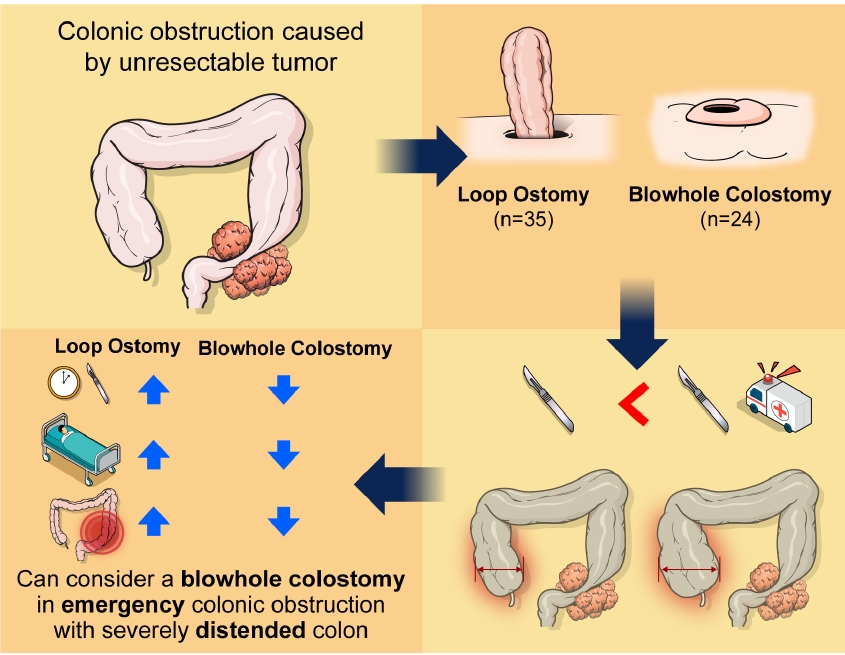
Surgery to create a stoma for decompression might be required for unresectable stage IV cancer patients with complete colonic obstruction. The aim of this study was to compare the results of blowhole colostomy with those of loop ostomy.
Methods
Palliative ileostomy or colostomy procedures performed at a single center between January 2011 and October 2020, were analyzed retrospectively. Fifty-nine patients were identified during this period. The demographic characteristics and outcomes between the blowhole colostomy group (n=24) and the loop ostomy group (n=35) were compared.
Results
The median operative time tended to be shorter in the blowhole colostomy group (52.5 minutes; interquartile range [IQR], 43–65) than in the loop ostomy group (60 minutes; IQR, 40–107), but the difference did not reach statistical significance (P=0.162). The median length of hospital stay was significantly shorter with blowhole colostomy (blowhole, 13 days [IQR, 9–23]; loop, 21 days [IQR, 14–37]; P=0.013). Mean cecum diameter was significantly larger in the blowhole group than in the loop group (8.83±1.91 cm vs. 6.78±2.36 cm, P=0.001), and the emergency operation rate was higher in the blowhole group than in the loop group (22 of 24 [91.7%] vs. 23 of 35 [65.7%], P=0.021).
Conclusion
In surgical emergencies, diverting a blowhole colostomy can be safe and effective for palliative management of colonic obstruction in patients with end-stage cancer and might reduce the operative time in emergent situations. -
Citations
Citations to this article as recorded by- Transverse blowhole colostomy versus Hartmann’s for urgent management of large bowel obstruction secondary to diverticular stricture
Hannah R. Liefeld, Kristen L. Coleman, Kelsey Lawrence, James W. Ogilvie
International Journal of Colorectal Disease.2026;[Epub] CrossRef - Palliative Transverse Blowhole Colostomy to Address Distal Colonic Obstruction in Advanced Peritoneal Malignancies: A Case Series
Lauren Marek, Nina DiMauro, Bridget Fahy, Alissa Greenbaum
Journal of Surgical Oncology.2026;[Epub] CrossRef - A Last Resort: Dacron Vascular Graft Prosthesis for Management of a Blowhole Colostomy
Brittney A. Ehrlich, Maria C. Unuvar, Justin M. Orenich, Rebecca L. Hoffman
The American Surgeon™.2025; 91(2): 303. CrossRef - Preventing Anastomotic Leakage, a Devastating Complication of Colorectal Surgery
Hyun Gu Lee
The Ewha Medical Journal.2023;[Epub] CrossRef - Stoma-Related Complications: A Single-Center Experience and Literature Review
Zalán Benedek, Loránd Kocsis, Orsolya Bauer, Nicolae Suciu, Sorin Sorlea, Călin Crăciun, Rareș Georgescu, Marius Florin Coroș
Journal of Interdisciplinary Medicine.2022; 7(2): 31. CrossRef
- Transverse blowhole colostomy versus Hartmann’s for urgent management of large bowel obstruction secondary to diverticular stricture
Malignant disease,Prognosis and adjuvant therapy,Colorectal cancer
- Comparison of the oncological outcomes of stenting as a bridge to surgery and surgery alone in stages II to III obstructive colorectal cancer: a retrospective study
- Hiroaki Uehara, Toshiyuki Yamazaki, Akira Iwaya, Hitoshi Kameyama, Masaru Komatsu, Motoharu Hirai
- Ann Coloproctol. 2022;38(3):235-243. Published online July 13, 2021
- DOI: https://doi.org/10.3393/ac.2020.01067.0152

- 10,733 View
- 235 Download
- 10 Web of Science
- 14 Citations
-
Graphical Abstract
Abstract
PDF
- Purpose
We evaluated the oncological outcomes of bridge to surgery (BTS) using stent compared with surgery alone for obstructive colorectal cancer.
Methods
Consecutive patients who underwent curative resection for stages II to III obstructive colorectal cancer at our institution from January 2009 to March 2020, were registered retrospectively and divided into 43 patients in the BTS group and 65 patients in the surgery alone group. We compared the surgical and oncological outcomes between the 2 groups.
Results
Stent-related perforation did not occur. One patient in whom the stent placement was unsuccessful underwent emergency surgery with poor decompression (clinical success rate, 97.7%). The pathological characteristics were not significantly different between the groups. The following surgical outcomes in the BTS group were superior to those in the surgery alone group; nonemergency surgery (P<0.001), surgical approach (P=0.006), and length of hospital stay (P=0.020). The median follow-up time was 44.9 months (range, 1.1–126.5 months). The 3-year relapse-free survival rates were 68.4% and 58.2% (P=0.411), and the overall survival rates were 78.3% and 88.2% (P=0.255) in the surgery alone and BTS groups, respectively. The 3-year locoregional recurrence rates were 10.2% and 8.0% (P=0.948), and distant metastatic recurrence rates were 13.3% and 30.4% (P=0.035) in the surgery alone and BTS groups, respectively.
Conclusion
This study revealed that BTS with stent may be associated with a higher frequency of distant metastatic recurrence. Stent for stages II to III obstructive colorectal cancer potentially worsens oncological outcomes. -
Citations
Citations to this article as recorded by- Stoma-free subtotal and total colectomy for obstructed left-sided colon cancer: safety, functional outcomes, and oncological results
Mustafa Kuşak, Mustafa Gün, Serdar Şenol
Journal of Medicine and Palliative Care.2026; 7(3): 580. CrossRef - Self-expandable metal stents as a bridge to surgery for obstructive colorectal cancer: a propensity score-matched retrospective cohort study
Jian-jun Chen, Zhu-lin Li, Yong Yang, Zhen-jun Wang
International Journal of Colorectal Disease.2026;[Epub] CrossRef - Controversial issues of colon stenting in case of tumor obstructive intestinal obstruction: surgical and oncological aspects
S.A. Aliyev, E.S. Aliyev, T.K. Aliyev
Endoscopic Surgery.2025; 31(2): 65. CrossRef - Transforming outcomes: the pivotal role of self-expanding metal stents in right- and left-sided malignant colorectal obstructions-bridge to surgery: a comprehensive review and meta-analysis
Sheza Malik, Priyadarshini Loganathan, Hajra Khan, Abul Hasan Shadali, Pradeep Yarra, Saurabh Chandan, Babu P. Mohan, Douglas G. Adler, Shivangi Kothari
Clinical Endoscopy.2025; 58(2): 240. CrossRef - A rare case of massive colonic distention secondary to undiagnosed colon adenocarcinoma
Chloe Lahoud, Toni Habib, Michel Al Achkar, Tyler Grantham, Nissar Ahmed
Medical Reports.2025; 12: 100207. CrossRef - Recurrence Rates and Postoperative Complications Following Colorectal Cancer Surgery: A 5-Year Study at a Tertiary Care Hospital in Peshawar
Tilal Ahmed Raza, Hussain Jan Abbasi, Farrukh Ozair, Hajra Imtiaz
Pakistan Journal of Health Sciences.2025; : 124. CrossRef - Complete Obstruction, a Real Risk Factor: A Comprehensive Study on Obstruction in Stage IIA Colon Cancer With Propensity Score Matching Analysis
Soo Young Oh, Chan Wook Kim, Seonok Kim, Min Hyun Kim, Young Il Kim, Jong Lyul Lee, Yong Sik Yoon, In Ja Park, Seok-Byung Lim, Chang Sik Yu
Clinical Colorectal Cancer.2024; 23(2): 135. CrossRef - Can we use colon stenting in accelerated recovery programs for surgical treatment colon cancer complicated by obstructive intestinal obstruction? A literature review
Saday A. Aliyev, Emil S. Aliyev
Russian Journal of Oncology.2024; 29(2): 130. CrossRef - Oncologic impact of colonic stents for obstructive left-sided colon cancer
Hideyuki Suzuki, Shingo Tsujinaka, Yoshihiro Sato, Tomoya Miura, Chikashi Shibata
World Journal of Clinical Oncology.2023; 14(1): 1. CrossRef - 5-year oncological outcomes in left-sided malignant colonic obstruction: stent as bridge to surgery
Noura S Alhassan, Sulaiman A AlShammari, Razan N AlRabah, Amirah M AlZahrani, Maha-Hamadien Abdulla, Thamer A Bin Traiki, Ahmad M Zubaidi, Omar A Al-Obeed, Khayal A Alkhayal
BMC Gastroenterology.2023;[Epub] CrossRef - Impact of Postoperative Naples Prognostic Score to Predict Survival in Patients with Stage II–III Colorectal Cancer
Su Hyeong Park, Hye Seung Woo, In Kyung Hong, Eun Jung Park
Cancers.2023; 15(20): 5098. CrossRef - Do Laparoscopic Approaches Ensure Oncological Safety and Prognosis for Serosa-Exposed Colon Cancer? A Comparative Study against the Open Approach
Ji-Hyun Seo, In-Ja Park
Cancers.2023; 15(21): 5211. CrossRef - Recurrence Patterns and Risk Factors after Curative Resection for Colorectal Cancer: Insights for Postoperative Surveillance Strategies
Hyo Seon Ryu, Jin Kim, Ye Ryung Park, Eun Hae Cho, Jeong Min Choo, Ji-Seon Kim, Se-Jin Baek, Jung-Myun Kwak
Cancers.2023; 15(24): 5791. CrossRef - Colonic stent for bridge to surgery for acute left-sided malignant colonic obstruction: A review of the literature after 2020
Margherita Binetti, Augusto Lauro, Valeria Tonini
World Journal of Clinical Oncology.2022; 13(12): 957. CrossRef
- Stoma-free subtotal and total colectomy for obstructed left-sided colon cancer: safety, functional outcomes, and oncological results
Malignant disease,Prognosis and adjuvant therapy,Colorectal cancer,Epidemiology & etiology
- Characteristics and outcomes of colorectal cancer surgery by age in a tertiary center in Korea: a retrospective review
- Tae-Hoon Lee, Jeong Min Choo, Jeong Sub Kim, Seon Hui Shin, Ji-Seon Kim, Se-Jin Baek, Jung-Myun Kwak, Jin Kim, Seon-Hahn Kim
- Ann Coloproctol. 2022;38(3):244-252. Published online November 4, 2021
- DOI: https://doi.org/10.3393/ac.2021.00619.0088
- 9,104 View
- 173 Download
- 14 Web of Science
- 17 Citations
-
Graphical Abstract
Abstract
PDF
- Purpose
Colorectal cancer (CRC) occurs in all age groups, and the application of treatment may vary according to age. The study was designed to identify the characteristics of CRC by age.
Methods
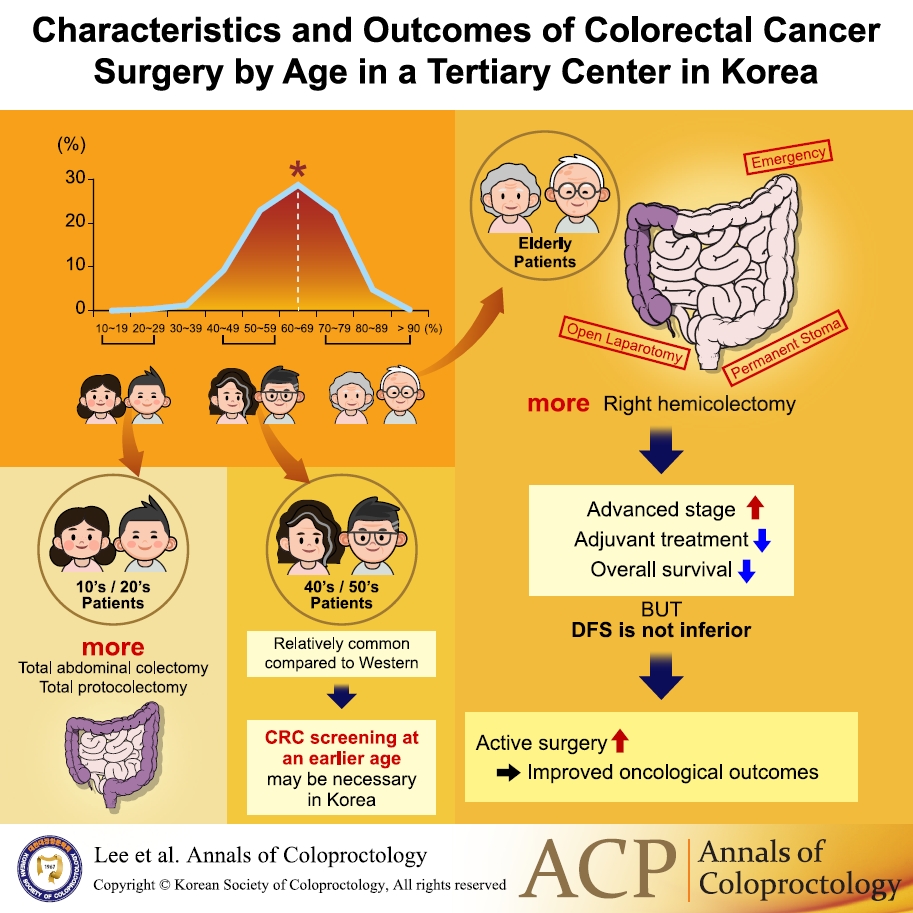
A total of 4,326 patients undergoing primary resection for CRC from September 2006 to July 2019 were reviewed. Patient and tumor characteristics, operative and postoperative data, and oncologic outcome were compared
Results
Patients aged 60 to 69 years comprised the largest age group (29.7%), followed by those aged 50 to 59 and 70 to 79 (24.5% and 23.9%, respectively). Rectal cancer was common in all age groups, but right-sided colon cancer tended to be more frequent in older patients. In very elderly patients, there were significant numbers of emergency surgeries, and the frequencies of open surgery and permanent stoma were greater. In contrast, total abdominal colectomy or total proctocolectomy was performed frequently in patients in their teens and twenties. The elderly patients showed more advanced tumor stages and postoperative ileus. The incidence of adjuvant treatment was low in elderly patients, who also had shorter follow-up periods. Overall survival was reduced in older patients with stages 0 to 3 CRC (P<0.001), but disease-free survival did not differ by age (P=0.391).
Conclusion
CRC screening at an earlier age than is currently undertaken may be necessary in Korea. In addition, improved surgical and oncological outcomes can be achieved through active treatment of the growing number of elderly CRC patients. -
Citations
Citations to this article as recorded by- Impact of Adjuvant Chemotherapy on the Prognosis in Elderly Patients with Stage II and III Colorectal Cancer: A Retrospective Multicenter Study
Eui Myung Kim, Il Son, Byung Chun Kim, Jun Park, Jin Won Lee, Jong Wan Kim
Cancer Management and Research.2026; Volume 18: 1. CrossRef - Survival following colorectal cancer resection in nonagenarians: A Swedish nationwide population-based study
Parisa G. Mörlin, Mojgan C. Sifolahzadeh, Maziar Nikberg, Peter Matthiessen, Abbas Chabok
Scandinavian Journal of Surgery.2026;[Epub] CrossRef - Effects of the Strength, Assistance in walking, Rise from a chair, Climb stairs, and Falls score on postoperative clinical outcomes following colorectal cancer surgery: a retrospective study
Young Jae Kim, Sung Uk Bae, Kyeong Eui Kim, Woon Kyung Jeong, Seong Kyu Baek
European Journal of Clinical Nutrition.2025; 79(4): 358. CrossRef - Immunological changes and recovery-related factors in older patients with colon cancer: A pilot trial
Byeo Lee Lim, Young Il Kim, Jong Lyul Lee, Chan Wook Kim, Yong Sik Yoon, Yousun Ko, Kyung Won Kim, In Ja Park
Journal of Geriatric Oncology.2025; 16(3): 102200. CrossRef - Comparison of body composition changes and nutritional status after surgery between older Japanese patients with upper and lower gastrointestinal cancer
Eiko Takano, Tsukasa Aritake, Kakeru Hashimoto, Yumi Suzuki, Yuichi Kitagawa, Ken Fujishiro, Yasuji Kawabata, Shinichirou Kobayashi, Izumi Kondo
The Journal of Aging Research & Lifestyle.2025; 14: 100006. CrossRef - Oncologic outcomes of surgically treated colorectal cancer in octogenarians: a comparative study using inverse probability of treatment weighting (IPTW)
Soo Young Oh, Jung Yun Park, Kwan Mo Yang, Seong-A Jeong, Yong Jae Kwon, Yun Tae Jung, Chung Hyeun Ma, Keong Won Yun, Kwang Hyun Yoon, Jae Young Kwak, Chang Sik Yu
BMC Gastroenterology.2025;[Epub] CrossRef - Oncologic outcomes and associated factors of colon cancer patients aged 70 years and older
Byeo Lee Lim, In Ja Park, Jun-Soo Ro, Young Il Kim, Seok-Byung Lim, Chang Sik Yu
Annals of Coloproctology.2025; 41(3): 198. CrossRef - Influence of additional prophylactic oral antibiotics during mechanical bowel preparation on surgical site infection in patients receiving colorectal surgery
Hayoung Lee, Jong Lyul Lee, Ji Sung Lee, Chan Wook Kim, Yong Sik Yoon, In Ja Park, Seok‐Byung Lim
World Journal of Surgery.2024; 48(6): 1534. CrossRef - Effect of Fluorescence Lymph Node Mapping on Improving Diagnostic Values of CT D3 Lymph Node Staging for Right-Sided Colon Cancer
Gyung Mo Son, Tae Un Kim, Mi Sook Yun, ChangYeop Kim, In Young Lee, Su Bum Park, Dong-Hoon Shin, Gi Won Ha
Cancers.2024; 16(20): 3496. CrossRef - Unveiling the profound advantages of total neoadjuvant therapy in rectal cancer: a trailblazing exploration
Kyung Uk Jung, Hyung Ook Kim, Hungdai Kim, Donghyoun Lee, Chinock Cheong
Annals of Surgical Treatment and Research.2023; 105(6): 341. CrossRef - The Latest Results and Future Directions of Research for Enhanced Recovery after Surgery in the Field of Colorectal Surgery
Min Ki Kim
The Ewha Medical Journal.2023;[Epub] CrossRef - Surgical Techniques for Transanal Local Excision for Early Rectal Cancer
Gyoung Tae Noh
The Ewha Medical Journal.2023;[Epub] CrossRef - Influence of the COVID-19 Pandemic on the Treatment Patterns and Outcomes of Colorectal Cancer
In Ja Park
The Ewha Medical Journal.2023;[Epub] CrossRef - Is the oncological impact of vascular invasion more important in right colon cancer?
Gyung Mo Son
Journal of Minimally Invasive Surgery.2022; 25(2): 49. CrossRef - Tailoring strategies for colorectal cancer screening and treatment based on age in colorectal cancer patients
Eun Jung Park
Annals of Coloproctology.2022; 38(3): 181. CrossRef - Surgical treatment for metastatic colorectal cancer
Eun Jung Park, Seung Hyuk Baik
Journal of the Korean Medical Association.2022; 65(9): 568. CrossRef - Recent Advance in the Surgical Treatment of Metastatic Colorectal Cancer-An English Version
Eun Jung Park, Seung Hyuk Baik
Journal of the Anus, Rectum and Colon.2022; 6(4): 213. CrossRef
- Impact of Adjuvant Chemotherapy on the Prognosis in Elderly Patients with Stage II and III Colorectal Cancer: A Retrospective Multicenter Study
 First
 Prev
- Page of 1
- Next

- Last

TOP


