 KSCP
 APFCP
 SIUCP-ETS
 NSCRD
 SCRS


Visual abstracts
- Page Path
- HOME > Browse Articles > Visual abstracts
Original Articles
ERAS
- Effect of continuous wound infiltration on patients using intravenous patient-controlled analgesia for pain management after reduced-port laparoscopic colorectal surgery
- Hyeon Deok Choi, Sung Uk Bae
- Ann Coloproctol. 2024;40(6):564-572. Published online November 22, 2024
- DOI: https://doi.org/10.3393/ac.2023.00143.0020

- 7,188 View
- 142 Download
- 2 Web of Science
- 3 Citations
-
 Graphical Abstract
 Abstract
 PDF
- Purpose
Continuous wound infiltration (CWI) has been introduced as a component of multimodal analgesia to counteract the adverse effects of the most frequently used opioids. Advantages of reduced-port laparoscopic surgery (RPLS) include cosmetic benefits and decreased postoperative pain. We aimed to investigate the effect of CWI in patients using intravenous (IV) patient-controlled analgesia (PCA) for pain management after RPLS for colorectal cancer.
Methods
This retrospective study included 25 patients who received both CWI (0.5% ropivacaine infused over 72 hours) and IV PCA (fentanyl citrate) and 52 patients who received IV PCA alone. The primary endpoint was pain scores on postoperative days (PODs) 0, 1, and 2. Univariate and multivariate analyses were conducted to determine the factors affecting the pain score on POD 0.
Results
On POD 0, the mean numeric rating scale score was significantly lower in the CWI group than in the control group (3.2±0.8 vs. 3.7±0.9, P=0.042). However, the scores were comparable between the groups during the rest of the period. Within 24 hours of surgery, the CWI group consumed fewer opioids (0.7±0.9 vs. 1.3±1.1, P=0.018) and more nonsteroidal anti-inflammatory drugs (2.0±1.4 vs. 1.3±1.4, P=0.046) than the control group. Time to removal of IV PCA was significantly longer in the CWI group than in the control group (4.4±1.6 days vs. 3.4±1.0 days, P=0.016).
Conclusion
CWI with ropivacaine and IV PCA was more effective than IV PCA alone in controlling postoperative pain within 24 hours of surgery, and opioid use could be reduced further. -
Citations
Citations to this article as recorded by
- Effects of epidural analgesia, regional blockade, and intravenous PCIA on early postoperative sleep disturbance and recovery outcomes after gastric and colorectal cancer surgery: a propensity score–based retrospective cohort study
Zhaojun Wu, Hejie Wang, Yu Li, Xiaoting Ren
BMC Anesthesiology.2026;[Epub] CrossRef - Subpleural continuous local anesthetic infusion as an opioid-sparing strategy after VATS lung resection: a prospective randomized controlled trial
Younggi Jung, Eunjue Yi, Sungho Lee, Jae Ho Chung
International Journal of Surgery.2026; 112(11): 14714. CrossRef - Optimizing postoperative pain management in minimally invasive colorectal surgery
Soo Young Lee
Annals of Coloproctology.2024; 40(6): 525. CrossRef
- Effects of epidural analgesia, regional blockade, and intravenous PCIA on early postoperative sleep disturbance and recovery outcomes after gastric and colorectal cancer surgery: a propensity score–based retrospective cohort study
Minimally invasive surgery
- New double-stapling technique without staple-crossing line in laparoscopic low anterior resection: effort to reduce anastomotic leakage
- Nam Seok Kim, Ji Hoon Kim, Yoon Suk Lee, In Kyu Lee, Won Kyung Kang
- Ann Coloproctol. 2024;40(6):573-579. Published online November 22, 2024
- DOI: https://doi.org/10.3393/ac.2022.00409.0058

- 8,593 View
- 224 Download
- 7 Web of Science
- 7 Citations
-
Graphical Abstract
Abstract
PDF
- Purpose
This study aimed to demonstrate the safety of new double-stapling technique (nDST), without a crossing line and dog ears, by comparing with conventional DST (cDST) in laparoscopic low anterior resection (LAR).
Methods
We retrospectively reviewed 98 consecutive patients who underwent laparoscopic LAR for rectal cancer from January 2018 to December 2020. The inclusion criterion was an anastomosis level below the peritoneal reflection and 4 cm above the anal verge. In the nDST group, the staple line of the linear cutter was sutured using barbed sutures to shorten the staple line before firing the circular stapler. Therefore, there were no crossing lines after firing the circular stapler. A 2:1 propensity score matching was performed between the cDST and nDST groups.
Results
After propensity score matching, 39 patients were in the cDST group and 20 were in the nDST group. There were no significant differences in patient demographics between the 2 groups. There was no difference in the total operation time between the cDST and nDST groups (124.0±26.2 minutes vs. 125.2±20.3 minutes, P=0.853). Morbidity rates were similar between the 2 groups (9 cases [23.1%] vs. 5 cases [25.0%], P=0.855). There was no significant difference in leakage rate (4 cases [10.3%] vs. 1 case [5.0%], P=0.847) and anastomotic bleeding rate (1 case [2.6%] vs. 3 cases [15.0%], P=0.211).
Conclusion
The nDST to eliminate the crossing line and dog ears in laparoscopic LAR is technically feasible and safe. However, more attention should be paid to anastomotic bleeding in such cases. -
Citations
Citations to this article as recorded by- Impact of circular stapler size on anastomotic complications after low colorectal anastomosis: a systematic review and meta-analysis
Maria C. STYLIANDI, Sascha VAGHIRI, Alireza PANDKHAHI, Alireza GHAFOURIANSAMEDANIMASHHAD, Irina DAVLETOVA, Ali M. KARIMI, Ali ALIPOURIANI, Andrea ALEXANDER, Hermann KESSLER, Wolfram T. KNOEFEL, Dimitrios PRASSAS
Minerva Surgery.2026;[Epub] CrossRef - Primary Anastomosis without Diversion in Perforated Diverticulitis: Is it Safe?
Sentilnathan Subramaniam, Michele Carvello, Jin-Jiun Mah, Davide Cuneo, Giorgia Gualtieri, Antonino Spinelli
Clinics in Colon and Rectal Surgery.2026;[Epub] CrossRef - Retrospective Analysis Study of Modified Bacon Procedure and Double Stapling Technique in Low Rectal Cancer Surgery
Xiaojun Tian, Tao Jiang, Yuehua Lei, Chen Zhang
The American Surgeon™.2026; 92(12): 3176. CrossRef - The application value of Da Vinci linear powered stapler SureForm in robotic sphincter-preserving surgery for rectal cancer: a prospective randomized clinical trial
Shan-ping Ye, Dong-ning Liu, Zheng-rong Li, Yi Cao, Bo Tang, Jin-yuan Duan, A-long Luo, Tai-yuan Li
Surgical Endoscopy.2026;[Epub] CrossRef - Technical overview and clinical outcomes of transabdominal strategies to eliminate or neutralize staple-line intersection during low anterior resection: a systematic review
Alfredo Annicchiarico, Gianpiero Gravante, Rossella Melcarne, Leonardo Vincenti, Arcangelo Picciariello
International Journal of Colorectal Disease.2026;[Epub] CrossRef - The robotic intracorporeal single-stapled anastomosis (RiSSA) technique in robotic left-sided colorectal resection: a technical note
Chih-Chien Wu, Yung-Lin Tan, Chao-Wen Hsu, Hsin-Ping Tseng, Danilo Miskovic, Shih-Feng Huang
Annals of Coloproctology.2025; 41(4): 357. CrossRef - Comparative perioperative outcomes of articulated versus conventional straight devices in laparoscopic low anterior resection: a propensity score–matched analysis
Hayoung Lee, Yong Sik Yoon, Young Il Kim, Min Hyun Kim, Jong Lyul Lee, Chan Wook Kim, In Ja Park, Seok-Byung Lim
Annals of Coloproctology.2025; 41(5): 434. CrossRef
- Impact of circular stapler size on anastomotic complications after low colorectal anastomosis: a systematic review and meta-analysis
Complication
- Early warning model to detect anastomotic leakage following colon surgery: a clinical observational study
- Pooya Rajabaleyan, Ravish Jootun, Sören Möller, Ulrik Deding, Mark Bremholm Ellebæk, Issam al-Najami, Ian Lindsey
- Ann Coloproctol. 2024;40(5):431-439. Published online October 8, 2024
- DOI: https://doi.org/10.3393/ac.2023.00745.0106

- 21,907 View
- 475 Download
- 11 Web of Science
- 12 Citations
-
Graphical Abstract
Abstract
PDF
- Purpose
We aimed to develop a predictive tool for anastomotic leakage (AL) following colon cancer surgery by combining a clinical early warning score (EWS) with the C-reactive protein (CRP) level.
Methods
The records of 1,855 patients who underwent colon cancer surgery at the Oxford University Hospitals NHS Foundation Trust between January 2013 and December 2018, with or without AL, were retrospectively reviewed. EWS and CRP levels were assessed daily from the first postoperative day until discharge. AL was defined as an anastomotic defect observed at reoperation, the presence of feculent fluid in a pelvic drain, or evidence of AL on computed tomography. The tool incorporated postoperative EWS and CRP levels for the accurate early detection of AL.
Results
From postoperative days 3 to 7, the mean CRP level exceeded 200 mg/L in patients with AL and was under 200 mg/L in those without AL (P<0.05). From postoperative days 1 to 5, the mean EWS among patients with leakage exceeded 2, while scores were below 2 among those without leakage (P<0.05). Receiver operating characteristic curve analysis identified postoperative day 3 as the most predictive of early leakage, with cutoff values of 2.4 for EWS and 180 mg/L for CRP; this yielded an area under the curve of 0.87 (sensitivity, 90%; specificity, 70%).
Conclusion
We propose using an EWS of 2.4 and a CRP level of 180 mg/L on postoperative day 3 following colon surgery with anastomosis as threshold values to prompt investigation and treatment of AL. -
Citations
Citations to this article as recorded by- The Clinical Presentation of Anastomotic Leakage Compared Between CRS-HIPEC and Conventional Colorectal Surgery
M. Cats, L. G. Magermans, E. C. E. Wassenaar, A. A. W. van Geloven, M. J. Wiezer, J. D. J. Plate, D. Boerma
Annals of Surgical Oncology.2026; 33(2): 1706. CrossRef - Anastomotic leak in colorectal surgery: Current evidence on risk, diagnosis, preventive measures and management
Ali Akbar Shah, Gevorg Manoukian, Omar Yasin, Amy Jacob, Timothy M. Kopah, Jas Simran Gill, Ruthel Rose, Bashayer Khaled Alharbi, Sana Zafar
Surgical Practice.2026;[Epub] CrossRef - Unplanned intensive care unit admission after elective colon cancer resection: population-based registry study
Sofia Dahlberg, Tomas Vedin, Ingvar Syk, Emma Larsson, Niklas Nielsen, Henrik Bergenfeldt
BJS Open.2026;[Epub] CrossRef - Late Anastomotic Leakage After Rectal Cancer Surgery: Incidence and Differential Risk Factors
Hyeon Kyeong Kim, In Ja Park, Jae Cheol Kang, Jong Lyul Lee, Chan Wook Kim, Yong Sik Yoon, Seok-Byung Lim
Diseases of the Colon & Rectum.2026; 69(4): 565. CrossRef - Risk factor analysis and nomogram model development for anastomotic leakage following laparoscopic radical colorectal cancer surgery
Zi-Hong He, Yang-Yang Zhou, Ruo-Nan Zhang, Yu-Shen He, Yan-Hong Jin, Fu-Hao Tian
World Journal of Surgical Oncology.2026;[Epub] CrossRef - Enhancing anastomosis safety with intraoperative perfusion assessment: a visual grading system for tailoring resection and ostomy formation in sigmoid colon and rectal cancer surgery
Soo Young Oh, Seok-Byung Lim, Eu-Tteum Choi, Min Hyun Kim, Young Il Kim, Jong Lyul Lee, Yong Sik Yoon, Chan Wook Kim, In Ja Park, Chang Sik Yu
Annals of Coloproctology.2026; 42(3): 303. CrossRef - Prevention and management of anastomotic leakage after colorectal resection: evolving trends among Italian surgeons. A SICCR survey
Renato Costi, Alfredo Annicchiarico, Antonio Amato, Cristina Folliero, Claudio Guerci, Alessandro Facchinetti, Filippo Montali, Adolfo Petrina, Agnese Dezi, Agostino Falcone, Agostino Fernicola, Alba Oliva, Alberto Buonanno, Alberto Porcu, Alberto Servent
Updates in Surgery.2026; 78(4): 1415. CrossRef - Perioperative trajectories of inflammatory and nutritional biomarkers in predicting anastomotic leakage after colon surgery
Denizhan Kılıç, Erhan Kızılkaya
Annals of Clinical and Analytical Medicine.2026; 17(10): 1111. CrossRef - Long-term oncologic outcomes associated with clinically significant anastomotic leakage after curative colorectal cancer surgery: Stage- and location-stratified analyses
Youngbae Jeon, Sun Jin Sym, Won-Suk Lee, Jeong-Heum Baek, Chong-Chi Chiu
PLOS One.2026; 21(10): e0359416. CrossRef - ‘Failure to rescue’ from anastomotic leak following colorectal cancer resection: An observational study from a binational registry
Cameron I. Wells, Wal Baraza, Greg O'Grady, Ian P. Bissett
Colorectal Disease.2025;[Epub] CrossRef - Early detection of anastomotic leakage in colon cancer surgery: the role of early warning score and C-reactive protein
Gyung Mo Son
Annals of Coloproctology.2024; 40(5): 415. CrossRef - Predictive Biomarkers for the Early Detection of Anastomotic Leaks in Colorectal Surgeries: A Systematic Review
Wahidullah Dost, Mohammad Qaher Rasully , Mohammad Nazir Zaman, Wahida Dost, Wahida Ali, Sami A Ayobi, Raisa Dost, Jamaluddin Niazi, Kinza Bakht, Asma Iqbal, Syed Faqeer Hussain Bokhari
Cureus.2024;[Epub] CrossRef
- The Clinical Presentation of Anastomotic Leakage Compared Between CRS-HIPEC and Conventional Colorectal Surgery
ERAS
- Impact of an Enhanced Recovery After Surgery (ERAS) program on the management of complications after laparoscopic or robotic colectomy for cancer
- Victoria Weets, Hélène Meillat, Jacques Emmanuel Saadoun, Marie Dazza, Cécile de Chaisemartin, Bernard Lelong
- Ann Coloproctol. 2024;40(5):440-450. Published online September 20, 2024
- DOI: https://doi.org/10.3393/ac.2023.00850.0121

- 15,556 View
- 289 Download
- 9 Web of Science
- 8 Citations
-
Graphical Abstract
Abstract
PDF
 Supplementary Material
- Purpose
Enhanced Recovery After Surgery (ERAS) reduces postoperative complications (POCs) after colorectal surgery; however, its impact on the management of POCs remains unclear. This study compared the diagnosis and management of POCs before and after implementing our ERAS protocol after laparoscopic or robotic colectomy for cancer and examined the short- and mid-term oncologic impacts.
Methods
This single-center, retrospective study evaluated all consecutive patients who underwent laparoscopic or robotic colectomy for cancer between 2012 and 2021, focusing on the incidence of POCs within 90 days. We compared outcomes before (standard group) and after (ERAS group) the implementation of our ERAS protocol in January 2016.
Results
Significantly fewer patients in the ERAS group developed POCs (standard vs. ERAS, 136 of 380 patients [35.8%] vs.136 of 660 patients [20.6%]; P<0.01). The ERAS group had a significantly shorter mean total length of stay after POCs (13.1 days vs. 11.4 days, P=0.04), and the rates of life-threatening complications (6.7% vs. 0.7%) and 1-year mortality (7.4% vs. 1.5%) were significantly lower in the ERAS group than in the standard group. Among patients with anastomotic complications, laparoscopic reoperation was significantly more common in the ERAS group than in the standard group (8.3% vs. 75.0%, P<0.01). Among patients with postoperative ileus, the diagnosis and recovery times were significantly shorter in the ERAS group than in the standard group, resulting in a shorter total length of stay (13.5 days vs. 10 days, P<0.01).
Conclusion
The implementation of an ERAS protocol did not eliminate all POCs, but it did accelerate their diagnosis and management and improved patient outcomes. -
Citations
Citations to this article as recorded by- The ultrasonographic measure of postoperative day 2 gastric volume may be a useful tool to improve the management of colorectal surgery patients: results of an ancillary study
Aurélien Venara, Anita Paisant, Julien Gillet, Lise Morgado, Emeline Rebmann, Jean-Francois Hamel
International Journal of Colorectal Disease.2026;[Epub] CrossRef - Perioperative impact of enhanced recovery after surgery (ERAS) for minimally invasive colorectal resection: a systematic review and meta-analysis
Kaiming Wen, Haoyang Wu, Bo-Wen Wu
Journal of Robotic Surgery.2026;[Epub] CrossRef - A cost comparison between patients undergoing robotic colorectal surgery with and without a clinical pathway
Alfonso Valenzuela Hurtado, Onur Bayram, Jörg Kleeff, Johannes Klose, Manuela De Allegri, Ulrich Ronellenfitsch
Cost Effectiveness and Resource Allocation.2026;[Epub] CrossRef - Lymphopenia and C-reactive protein elevation on postoperative day 2 are independent risk factors for occurrence of major and minor complications in elective colorectal cancer surgery
Minsuh Park, Kyung Jong Kim, Young-hun Kim
Annals of Coloproctology.2026; 42(3): 333. CrossRef - Less is more: simplifying patient-centered cancer care
In Ja Park
Annals of Coloproctology.2025; 41(3): 173. CrossRef - Research Progress on the Application of ERAS Concept in the Perioperative Period of Colorectal Cancer Patients
梦云 孙
Advances in Clinical Medicine.2025; 15(08): 1208. CrossRef - Can Surgical Approach and Postoperative Factors Impact Survival in Rectal Cancer? Robotic Versus Laparoscopic Insights
Ahmed Abdelsamad, Seyidali Mirzazada, Karsten Ridwelski, Mohamad Nour Nasif, Florian Gebauer
Cancer Medicine.2025;[Epub] CrossRef - Optimizing postoperative pain management in minimally invasive colorectal surgery
Soo Young Lee
Annals of Coloproctology.2024; 40(6): 525. CrossRef
- The ultrasonographic measure of postoperative day 2 gastric volume may be a useful tool to improve the management of colorectal surgery patients: results of an ancillary study
ERAS
- Clinical impact of a multimodal pain management protocol for loop ileostomy reversal
- Jeong Sub Kim, Chul Seung Lee, Jung Hoon Bae, Seung Rim Han, Do Sang Lee, In Kyu Lee, Yoon Suk Lee, In Kyeong Kim
- Ann Coloproctol. 2024;40(3):210-216. Published online June 19, 2024
- DOI: https://doi.org/10.3393/ac.2022.01137.0162

- 9,335 View
- 261 Download
- 5 Web of Science
- 7 Citations
-
Graphical Abstract
Abstract
PDF
- Purpose
As introduced, multimodal pain management bundle for ileostomy reversal may be considered to reduce postoperative pain and hospital stay. The aim of this study was to evaluate clinical efficacy of perioperative multimodal pain bundle for ileostomy.
Methods
Medical records of patients who underwent ileostomy reversal after rectal cancer surgery from April 2017 to March 2020 were analyzed. Sixty-seven patients received multimodal pain bundle protocol with ileostomy reversal (group A) and 41 patients underwent closure of ileostomy with conventional pain management (group B).
Results
Baseline characteristics, including age, sex, body mass index, American Society of Anesthesiologists classification, diabetes mellitus, and smoking history, were not significantly different between the groups. The pain score on postoperative day 1 was significant lower in group A (visual analog scale, 2.6 ± 1.3 vs. 3.2 ± 1.2; P = 0.013). Overall consumption of opioid in group A was significant less than group B (9.7 ± 9.5 vs. 21.2 ± 8.8, P < 0.001). Hospital stay was significantly shorter in group A (2.3 ± 1.5 days vs. 4.1 ± 1.5 days, P < 0.001). There were no significant differences between the groups in postoperative complication rate.
Conclusion
Multimodal pain protocol for ileostomy reversal could reduce postoperative pain, usage of opioid and hospital stay compared to conventional pain management. -
Citations
Citations to this article as recorded by- Application of Enhanced Recovery After Surgery in high-risk patients undergoing colon cancer surgery: a retrospective cohort study
Reem Mohammed H. Alshiakh, In Kyeong Kim, Jung Hoon Bae, Yoon Suk Lee, In Kyu Lee
Annals of Surgical Treatment and Research.2026; 110(4): 205. CrossRef - Comparison of Balanced Analgesia and Conventional Analgesia on Postoperative Pain and Recovery
Abdullah Al Mamun, Md Zaheedun Nabi, Mithun Mahbub Khan, Arufa Akhtar Mousumi
TAJ: Journal of Teachers Association.2026; 39(2): 101. CrossRef - Immunological changes and recovery-related factors in older patients with colon cancer: A pilot trial
Byeo Lee Lim, Young Il Kim, Jong Lyul Lee, Chan Wook Kim, Yong Sik Yoon, Yousun Ko, Kyung Won Kim, In Ja Park
Journal of Geriatric Oncology.2025; 16(3): 102200. CrossRef - Quadratus lumborum block for postoperative pain management in patients undergoing ileostomy closure: a prospective, randomized controlled trial
Su Jin Kang, Soo Yeun Park, Jun Seok Park, Jinseok Yeo
Journal of Yeungnam Medical Science.2025; 43: 5. CrossRef - Multimodal analgesia for postoperative pain: pursuing liberation from pain, not redemption
Soo Yeun Park
Annals of Coloproctology.2024; 40(3): 189. CrossRef - Clinical outcomes and future directions of enhanced recovery after surgery in colorectal surgery: a narrative review
Ji Hyeong Song, Minsung Kim
The Ewha Medical Journal.2024;[Epub] CrossRef - Optimizing postoperative pain management in minimally invasive colorectal surgery
Soo Young Lee
Annals of Coloproctology.2024; 40(6): 525. CrossRef
- Application of Enhanced Recovery After Surgery in high-risk patients undergoing colon cancer surgery: a retrospective cohort study
Minimally invasive surgery
- Preoperative localization of potentially invisible colonic lesions on the laparoscopic operation field: using autologous blood tattooing
- Ji Yeon Mun, Hyunjoon An, Ri Na Yoo, Hyeon-Min Cho, Bong-Hyeon Kye
- Ann Coloproctol. 2024;40(3):225-233. Published online June 19, 2024
- DOI: https://doi.org/10.3393/ac.2023.00059.0008

- 7,499 View
- 221 Download
- 2 Web of Science
- 2 Citations
-
Graphical Abstract
Abstract
PDF
- Purpose
Preoperative colonoscopic (POC) localization is recommended for patients scheduled for elective laparoscopic colectomy for early colon cancer. Among the various localization method, POC tattooing localization has been widely used. Several dyes have been used for tattooing, but dye has disadvantages, including foreign body reactions. For this reason, we have used autologous blood tattooing for POC localization. This study aimed to evaluate the safety and efficacy of the autologous blood tattooing method.
Methods
This study included patients who required POC localization of the colonic neoplasm among the patients who were scheduled for elective colon resection. The indication for localization was early colon cancer (clinically T1 or T2) or colonic neoplasms that could not be resected endoscopically. POC autologous blood tattooing was performed after saline injection, and 2 hemoclips were applied.
Results
A total of 45 patients who underwent autologous blood tattooing and laparoscopic colectomy were included in this study. All POC localization sites were visible in the laparoscopic view. POC localization sites showed almost perfect agreement with intraoperative surgical findings. There were no complications like bowel perforation, peritonitis, hemoperitoneum, and mesenteric hematoma.
Conclusion
Autologous blood is a safe and effective agent for localizing materials that can replace previous dyes. However, a large prospective case-control study is required for the routine application of this procedure in early colon cancer or colonic neoplasms. -
Citations
Citations to this article as recorded by- Meeting report on the 8th Asian Science Editors’ Conference and Workshop 2024
Eun Jung Park
Science Editing.2025; 12(1): 66. CrossRef - Preoperative Localization, Margins, and Intraoperative Endoscopy in Minimally Invasive Sigmoid Colectomy: A Matched Cohort
Chang-Lin Lin, Feng-Fan Chiang, Ming-Cheng Chen, Chun-Yu Lin, Shang-Chih Huang, Ching-Shiang Lin
Journal of Surgical Research.2025; 315: 847. CrossRef
- Meeting report on the 8th Asian Science Editors’ Conference and Workshop 2024
Benign bowel disease
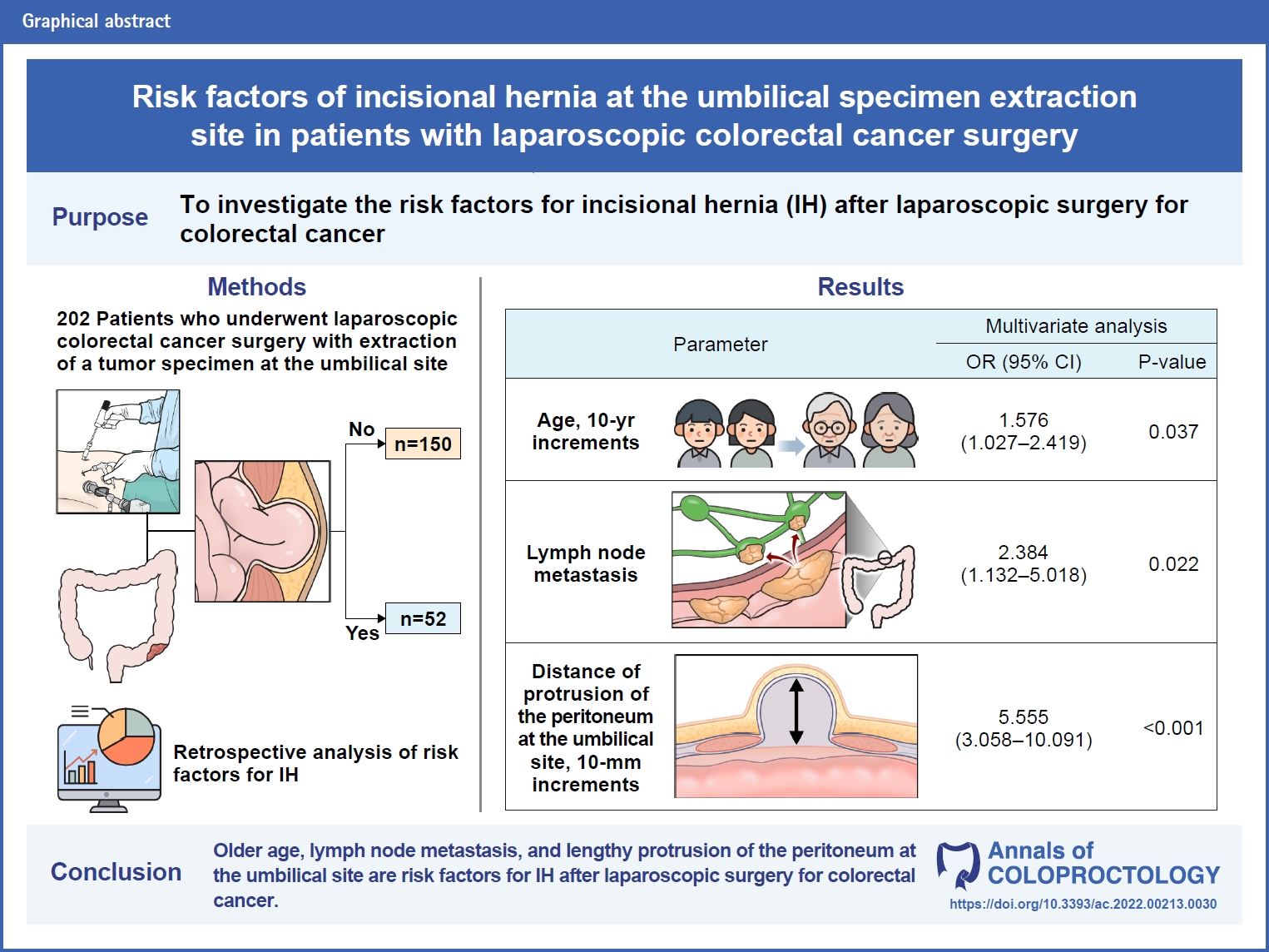
- Risk factors of incisional hernia at the umbilical specimen extraction site in patients with laparoscopic colorectal cancer surgery
- Masatsugu Hiraki, Toshiya Tanaka, Shinya Azama, Eiji Sadashima, Hirofumi Sato, Shuusuke Miyake, Kenji Kitahara
- Ann Coloproctol. 2024;40(2):136-144. Published online June 21, 2022
- DOI: https://doi.org/10.3393/ac.2022.00213.0030
- 9,781 View
- 217 Download
- 8 Web of Science
- 10 Citations
-
Graphical Abstract
Abstract
PDF
- Purpose
Incisional hernia (IH) is a frequent complication following laparoscopic colorectal surgery. The present study investigated the risk factors for IH after laparoscopic surgery for colorectal cancer.
Methods
A retrospective study was conducted on 202 patients who underwent laparoscopic surgery for colorectal cancer. Univariate and multivariate analyses were performed to determine the clinicopathological factors associated with IH.
Results
The overall incidence of IH was 25.7% (52 of 202). The univariate analysis showed that female sex (P=0.004), a high body mass index (P<0.001), noncurrent smoking habit (P=0.043), low level of hemoglobin (P=0.035), high subcutaneous fat area (P<0.001), high visceral fat area (P=0.006), low skeletal muscle area (P=0.001), long distance between the inner edges of the rectus abdominis muscle (P=0.001), long protrusion of the peritoneum at the umbilical site (P<0.001), and lymph node metastasis (P=0.007) were significantly more frequent in the group with IH than in the group without it. The multivariate logistic regression analysis revealed an older age (10-year increments: odds ratio [OR], 1.576; 95% confidence interval [CI], 1.027–2.419; P=0.037), lymph node metastasis (OR, 2.384; 95% CI, 1.132–5.018; P=0.022) and lengthy protrusion of the peritoneum at the umbilical site (10-mm increments: OR, 5.555; 95% CI, 3.058–10.091; P<0.001) were independent risk factors for IH.
Conclusion
Our findings suggest that older age, lymph node metastasis, and lengthy protrusion of the peritoneum at the umbilical site are risk factors for IH after laparoscopic surgery for colorectal cancer. An assessment using these factors before the operation and the implementation of countermeasures might help prevent IH. -
Citations
Citations to this article as recorded by- Umbilical fat is useful for evaluating the risk of incisional hernia after laparoscopic colorectal surgery
Chika Katayama, Yasuaki Enokida, Takuya Shiraishi, Yuta Shibasaki, Takuhisa Okada, Katsuya Osone, Akihiko Sano, Makoto Sakai, Hiroomi Ogawa, Ken Shirabe, Hiroshi Saeki
Surgery Today.2026; 56(4): 496. CrossRef - Incisional hernia after continuous barbed versus interrupted non-barbed sutures for midline fascial closure in minimally invasive colorectal cancer surgery: a propensity score-matched analysis
Kinuko Nagayoshi, Yusuke Mizuuchi, Takaaki Fujimoto, Koji Tamura, Kohei Nakata, Kenoki Ohuchida, Masafumi Nakamura
Hernia.2026;[Epub] CrossRef - CT-Derived Predictors of Incisional Hernia Following Colorectal Cancer Resection: A Systematic Review
Mohamed Alfatih Hamza, Omar Abu Saadeh, Hugo C. Temperley, Niall J. O’Sullivan, Benjamin M. Mac Curtain, Mohammed Khalifa, Abdelrazig Salih, Peter Beddy, Paul H. McCormick, Jeeban Paul Das, Michael E. Kelly
Diagnostics.2026; 16(15): 2345. CrossRef - Comparative analysis of longitudinal and transverse minilaparotomy during colon cancer surgery
Z.A. Bagatelija, D.N. Grekov, S.S. Lebedev, V.M. Kulushev, N.Ju. Sokolov, G.S. Mikhailyants, A.Yu. Lukin, A.A. Polikarpov, M.S. Lebedko, A.I. Maksimkin, A.S. Sharenkova
Pirogov Russian Journal of Surgery.2025; (4): 71. CrossRef - Effect of transverse versus midline periumbilical incision on incisional hernia and short-term outcomes after laparoscopic colon cancer surgery: multicentre, open-label, randomized clinical trial
Soo Young Lee, Soo Yeun Park, Gi Won Ha, Gyung Mo Son, Dong Keon Yon, Chang Hyun Kim, S Kim, S I Kang, J S Park, K H Lee, J S Kim, K B Bae, S U Bae
BJS Open.2025;[Epub] CrossRef - Subcutaneous Fat, Not Visceral Fat, as a Risk Factor for Incisional Hernia After Laparoscopic Colorectal Cancer Surgery
Kumiko Sekiguchi, Akihisa Matsuda, Takeshi Yamada, Satoshi Matsumoto, Keisuke Minamimura, Youichi Kawano, Takeshi Matsutani, Hiroshi Maruyama, Nobuhiko Taniai, Yoshiharu Nakamura, Hiroshi Yoshida
Asian Journal of Endoscopic Surgery.2025;[Epub] CrossRef - Outcomes of elective and emergency surgical repair of incisional hernia: a comparative observational study
I. Omar, A. Townsend, O. Hadfield, T. Zaimis, M. Ismaiel, J. Wilson, C. Magee
Hernia.2024; 28(5): 1619. CrossRef - The first case of robotic‐assisted transabdominal retrorectus repair for incisional hernia in Japan
Gen Shimada, Taketo Matsubara, Mariko Sanbonmatsu, Rumi Nakabayashi, Yosuke Miyachi, Takashi Taketa, Akihiro Suzuki, Tadao Yokoi, Toshimi Kaido
Asian Journal of Endoscopic Surgery.2023; 16(2): 305. CrossRef - Mid-term outcomes of intracorporeal versus extracorporeal anastomosis after laparoscopic colectomy: a propensity score-matched cohort study from a single institution
Heita Ozawa, Naoyuki Toyota, Junichi Sakamoto, Hiroki Nakanishi, Ryo Nakanishi, Shin Fujita
Surgery Today.2023; 53(8): 992. CrossRef - Impact of non-muscle cutting periumbilical transverse incision on the risk of incisional hernia as compared to midline incision during laparoscopic colon cancer surgery: a study protocol for a multi-centre randomised controlled trial
Soo Yeun Park, Gi Won Ha, Soo Young Lee, Chang Hyun Kim, Gyung Mo Son
Trials.2023;[Epub] CrossRef
- Umbilical fat is useful for evaluating the risk of incisional hernia after laparoscopic colorectal surgery
Colorectal cancer
- Public effect of the 2022 Colorectal Cancer Awareness Campaign delivered through a metaverse platform
- Tae-Gyun Lee, Gil-Hyeon Song, Hong-min Ahn, Heung-Kwon Oh, Moonkyoung Byun, Eon Chul Han, Sohyun Kim, Chang Woo Kim, Hye Jin Kim, Samin Hong, Kee-Ho Song, Chan Wook Kim, Yong Beom Cho, on behalf of the Public Relations Committee of the Korean Society of Coloproctology (KSCP)
- Ann Coloproctol. 2024;40(2):145-153. Published online April 28, 2023
- DOI: https://doi.org/10.3393/ac.2023.00122.0017

- 16,340 View
- 189 Download
- 8 Web of Science
- 9 Citations
-
Graphical Abstract
Abstract
PDF
- Purpose
The Korean Society of Coloproctology has been conducting Colorectal Cancer Awareness Campaign, also known as the Gold Ribbon Campaign, every September since 2007. The 2022 campaign was held through a metaverse platform targeting the younger age group under the slogan of raising awareness of early-onset colorectal cancer (CRC). This study aimed to analyze the impact of the 2022 campaign on a metaverse platform.
Methods
Anonymized survey data were collected from participants in the metaverse campaign from September 1 to 15, 2022. The satisfaction score of the participants was evaluated by sex, age group, and previous campaign participation status.
Results
During the campaign, 2,770 people visited the metaverse. Among them, 455 people participated in the survey (response rate, 16.4%). Approximately 95% of the participants reported being satisfied with the information provided by the campaign, understood the necessity of undergoing screening for and prevention of early-onset CRC, and were familiar with the structure of the metaverse. The satisfaction score for campaign information tended to decrease as the participants’ age increased. When the participants’ overall level of satisfaction with the metaverse platform was assessed, teenagers scored particularly lower than the other age groups. The satisfaction scores for CRC information provided in the metaverse, as well as the scores for recognizing the seriousness and necessity of screening for early-onset CRC, indicated a high positive tendency (P<0.001).
Conclusion
Most of the 2022 Gold Ribbon Campaign participants were satisfied with the metaverse platform. Medical society should pay attention to increasing participation in and satisfaction with future public campaigns. -
Citations
Citations to this article as recorded by- Metaverse in surgery — origins and future potential
Enrico Checcucci, Alessandro Veccia, Stefano Puliatti, Pieter De Backer, Pietro Piazza, Karl-Friedrich Kowalewski, Severin Rodler, Mark Taratkin, Ines Rivero Belenchon, Loic Baekelandt, Sabrina De Cillis, Alberto Piana, Ahmed Eissa, Juan Gomez Rivas, Giov
Nature Reviews Urology.2026; 23(1): 50. CrossRef - CONGA: CONscientization GAme for Colon Cancer Literacy in Last-Semester Software Engineering Students
Franklin Parrales-Bravo, Jonatan Guillen-Salabarria, Janio Jadán-Guerrero, Leonel Vasquez-Cevallos
Computers.2026; 15(3): 143. CrossRef - Translational Validation of a Novel Multi-Locus ctDNA Methylation Assay for Early Detection and Stratification of Colorectal Cancer: An Exploratory Prospective, Case-Control Study
Hayoung Lee, Jae Cheol Kang, In Ja Park, Gwang-un Kim, Hwi Hyun, Na Young Min, Sungwon Jeon, Byoung-Chul Kim
International Journal of Molecular Sciences.2026; 27(13): 5738. CrossRef - Integrating the Metaverse Into Medical Practice: A Systematic Review of Its Potential and Applications
Marsa Gholamzadeh, Shahryar Naji, Elmira Khakvatan, Mohammad Heydari, Saman Mortezaei, Nadeem Sarwar
International Journal of Telemedicine and Applications.2026;[Epub] CrossRef - Meeting report on the 8th Asian Science Editors’ Conference and Workshop 2024
Eun Jung Park
Science Editing.2025; 12(1): 66. CrossRef - Toward Diagnosis of Diseases Using Emerging Technologies: A Comprehensive Survey of the State of the Art in Metaverse
Nasim Aslani, Ali Garavand, Riccardo Ortale
International Journal of Intelligent Systems.2025;[Epub] CrossRef - Global perspectives on young-onset colorectal cancer: epidemiology, challenges, and advances
Drew Goldberg, Erica Pettke
Seminars in Colon and Rectal Surgery.2025; 36(3): 101118. CrossRef - #CRCandMe: results of a pre-post quasi-experimental study of a mass media campaign to increase early-onset colorectal cancer awareness in Utah and Wisconsin
Ami E Sedani
American Journal of Cancer Research.2024; 14(8): 3873. CrossRef - Metaverso: perspectivas, possibilidades e limitações
Walter Rodrigues Marques, Maria Neuraildes Gomes Viana, Anderson Boás Viana, Luís Claúdio Azevedo Gomes, Francilene Silva Cruz, Bruna Monique Cunha Rodrigues, Andréa Luísa Frazão Silva, Regeanne Santos Guaianaz, Daiane Leite Chaves Bezerra, Diêgo Jorge Lo
Caderno Pedagógico.2024; 21(13): e12984. CrossRef
- Metaverse in surgery — origins and future potential
Anorectal benign disease
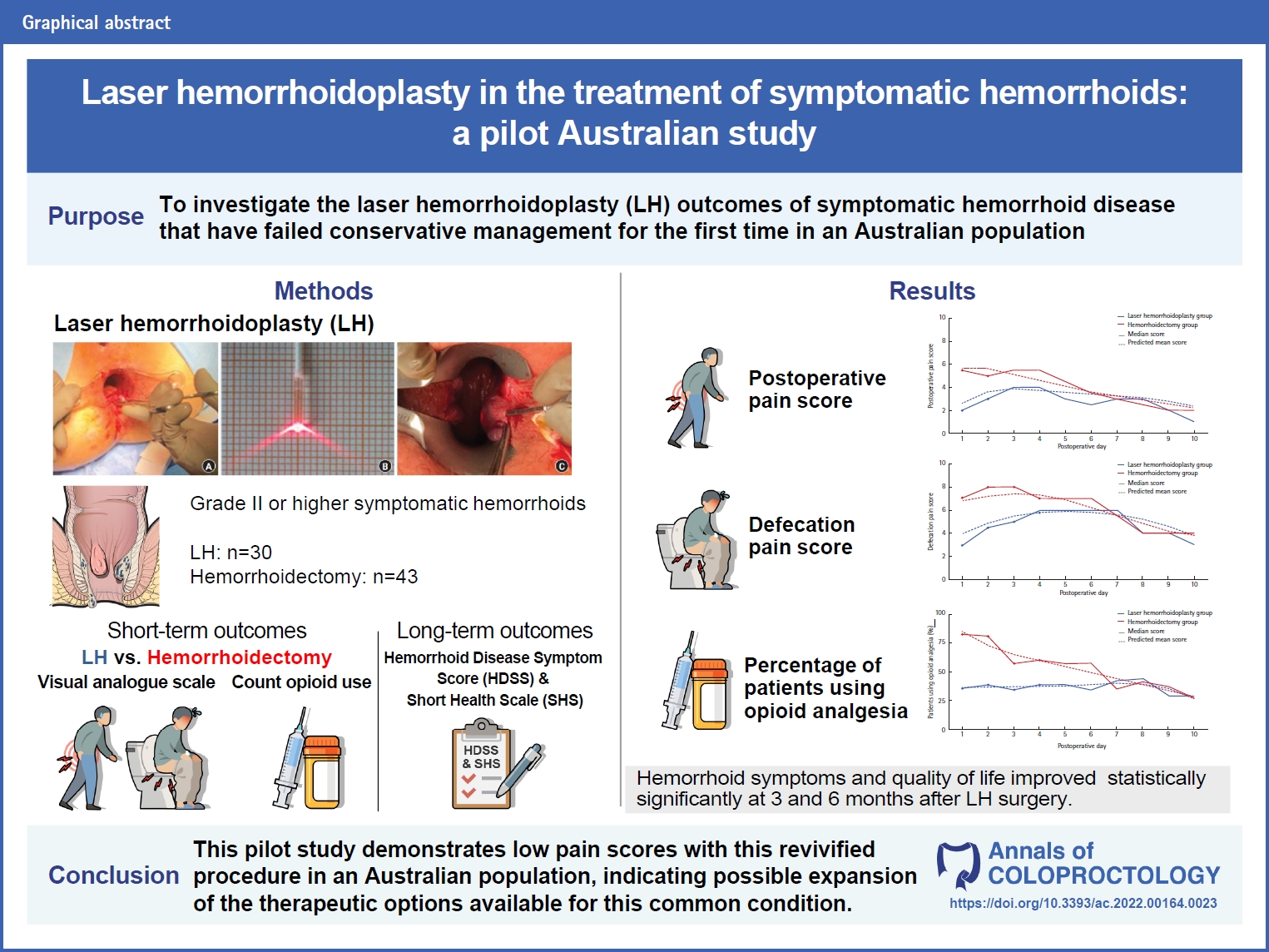
- Laser hemorrhoidoplasty in the treatment of symptomatic hemorrhoids: a pilot Australian study
- Anshini Jain, Chen Lew, Gamze Aksakal, Richard Hiscock, Naseem Mirbagheri
- Ann Coloproctol. 2024;40(1):52-61. Published online May 19, 2022
- DOI: https://doi.org/10.3393/ac.2022.00164.0023
- 30,293 View
- 670 Download
- 16 Web of Science
- 24 Citations
-
Graphical Abstract
Abstract
PDF
- Purpose
Traditional therapeutic approaches to the surgical management of hemorrhoid disease such as hemorrhoidectomies are plagued with severe postoperative pain and protracted recovery. Our pilot study aims to the laser hemorrhoidoplasty (LH) patients with symptomatic hemorrhoid disease that have failed conservative management for the first time in an Australian population.
Methods
Thirty patients were prospectively enrolled to undergo LH. Postoperative pain, time to return to function, and quality of life (QoL) were determined through the Hemorrhoid Disease Symptom Score and Short Health Scale adapted for hemorrhoidal disease and compared to a historical group of 43 patients who underwent a Milligan-Morgan hemorrhoidectomy by the same surgeon at 3, 6, and 12 months.
Results
The LH group had significantly lower mean predicted pain scores on days 1 and 2 and lower defecation pain scores and lower opioid analgesia use on days 1, 2, 3, and 4. The median time to return to normal function was significantly lower in the LH group (2 days vs. 9 days, P<0.001). Similarly, the median days to return to the workplace was significantly lower in the LH group (6 days vs. 13 days, P=0.007). During long-term follow-up (12 months), hemorrhoid symptoms and all QoL measures were significantly improved, especially among those with grade II to III disease.
Conclusion
This pilot study demonstrates low pain scores with this revivified procedure in an Australian population, indicating possible expansion of the therapeutic options available for this common condition. Further head-to-head studies comparing LH to other hemorrhoid therapies are required to further determine the most efficacious therapeutic approach. -
Citations
Citations to this article as recorded by- Laser Hemorrhoidoplasty for Grade III Hemorrhoidal Disease: Safety and Efficacy in a Brazilian Multicenter Retrospective Cohort Study
Fabrício Doin Paz de Oliveira, Bruno Lorenzo Scolaro, Ana Carolina Buffara Blitzkow, Sonia Cristina Cordero Time, Alline Maciel Pinheiro Borges, Thais Alencar Pinto dos Santos, Alfadl Abdulfattah, Elisa Treptow Marques Lemos, Glicia Estevam de Abreu
Photobiomodulation, Photomedicine, and Laser Surgery.2026; 44(3): 184. CrossRef - RISKS OF COMPLICATIONS AND STATISTICAL CRITERION OF “ODDS RATIO” (OR) AS INDICATORS OF THE EFFECTIVENESS OF LASER VAPORIZATION OF HEMORRHOIDAL VESSELS
K Satanova, A Fursov, R Fursov, A Kaipova, A Talassov
BULLETIN OF SURGERY OF KAZAKHSTAN.2026; 22(1): 58. CrossRef - Comparative Study of Open versus Laser Hemorrhoidectomy: Operative Duration and Postoperative Outcomes
Aswin Kumar G. S., Kannaki R., Dinesh Mukil N.
Indian Journal of Surgery.2026;[Epub] CrossRef - Morphological changes in hemorrhoidal tissue exposed to laser radiation at 8, 9, 10 W: an experimental study
Aleksander A. Zasorin, Dmitry M. Sozonov, Olga A. Mikheeva
Perm Medical Journal.2026; 43(4): 145. CrossRef - MODERN SURGICAL METHODS FOR TREATMENT OF PATIENTS WITH CHRONIC HEMORRHOIDS
Konstantin Igorevich Sergatskiy, Darina Vladimirovna Ulybina, Valeriy Isaakovich Nikol'skiy, Farit Khasyanovich Ablyaev, Aleksandr Semenovich Ivachev
Ulyanovsk Medico-biological Journal.2026; (3): 21. CrossRef - Best clinical practice recommendations for the management of symptomatic hemorrhoids via laser hemorrhoidoplasty: the LHP recommendations
P. C. Ambe, G. P. Martin-Martin, N. Vasas, I. Piponski, I. H. Roman, J. D. P. Hernandez, H. Ma, H.C. Lin, G. Weyand, L. Mazlan, L. J. García Flórez, K. Wolff, M. Dessily, C. Wang, V. Dobricanin, W. Yang, T. Bruketa, X.D. Zeng, S. Avdicausevic, Z.G. Zhang,
Techniques in Coloproctology.2025;[Epub] CrossRef - Latest Research Trends on the Management of Hemorrhoids
Sung Il Kang
Journal of the Anus, Rectum and Colon.2025; 9(2): 179. CrossRef - Evaluation of Doppler-guided Hemorrhoid Artery Ligation and Recto anal Repair Procedure: A Single-center Analysis in Indonesia
Amanda Putri Halim, Livia Taniwangsa, Joanna A. Kosasih, Anthony Berlim Lioe
Indian Journal of Colo-Rectal Surgery.2025; 8(1): 9. CrossRef - Laser Hemorrhoidoplasty: Procedure, Outcomes and Future Directions
Michele di Schiano di Visconte
ANZ Journal of Surgery.2025; 95(11): 2301. CrossRef - Evaluating Laser Haemorrhoidoplasty as a Short-Term Approach to Advanced Haemorrhoidal Disease
Chin Kiat Tan, Shou Kee Ng, Arijit Mukherjee
Cureus.2025;[Epub] CrossRef - The Outcome of Laser Ablation Hemorrhoidoplasty versus Conventional Hemorrhoidectomy
Mohammed Yousef Alessa, Loai Saleh Albinsaad, Arshadullah Khan, Laila Zamil Alzamil, Raghad Mabrouk Alanazi, Najd Mabrouk Alanazi, Abeer Mabrouk Alanazi
Annals of African Medicine.2025; 24(4): 811. CrossRef - Laser Hemorrhoidoplasty: Postoperative Outcomes and Predictive Factors for Pain, Bleeding, and Recovery
Laurențiu Augustus Barbu, Nicolae-Dragoș Mărgăritescu, Liliana Cercelaru, Tiberiu Stefăniță Țenea Cojan, Mădălina Costinela Stănică, Irina Enăchescu, Ana-Maria Țenea Cojan, Valentina Căluianu, Gabriel Florin Răzvan Mogoș, Liviu Vasile
Life.2025; 15(11): 1777. CrossRef - Comparison of Laser Hemorrhoidoplasty vs Conventional Milligan Morgan Procedure a Randomized Control Trial
. Muhammad, Farooq Ahmad, Kamran Malik, Aiqa Gulshan, Muhammad Ali Hassan, Nimra Shafi, . Fatima
Biological and Clinical Sciences Research Journal.2025; 6(10): 107. CrossRef - Laser hemorrhoidoplasty versus LigaSure™ hemorrhoidectomy versus diathermy hemorrhoidectomy in treatment of grade III and IV Hemorrhoids: A non-randomized prospective trial
Mohammad Ashour Khadr, Walid Galal El Shazly, Mohamed Mazloum Zakria, Ahmed Mohamed Moaz
Surgery Open Digestive Advance.2024; 13: 100129. CrossRef - Comparison of Laser Hemorrhoidoplasty and Milligan-Morgan Hemorrhoidectomy Techniques in the Treatment of Grade 2 and 3 Hemorrhoidal Disease
Adas Cemil, Kesici Ugur, Genc M. Salih, Karadag Merve, Duman M. Guray, Boluk S. Emine
The American Surgeon™.2024; 90(4): 662. CrossRef - Global International Society of University Colon and Rectal Surgeons in collaboration with European Society of Coloproctology audit on office‐based and surgical treatment of haemorrhoidal disease: Study protocol
Audrius Dulskas, Dovile Cerkauskaite, Joseph Nunoo‐Mensah, Richard Fortunato, Gaetano Gallo, Alaa El Hussuna, Varut Lohsiriwat, Tomas Aukstikalnis, Narimantas E. Samalavicius
Colorectal Disease.2024; 26(6): 1266. CrossRef - Ethnomedical knowledge of plants used in alternative medicine to treat hemorrhoidal diseases in Lubumbashi, Haut-Katanga province, Southern Democratic Republic of Congo
Bashige Chiribagula Valentin, Okusa Ndjolo Philippe, Muhona Melman, Manya Mboni Henry, Bakari Amuri Salvius, Lumbu Simbi Jean Baptiste
BMC Complementary Medicine and Therapies.2024;[Epub] CrossRef - Outcomes of laser hemorrhoidoplasty for grade II–IV hemorrhoidal disease in Bangladesh
Md. Saiful Islam, Abhigan B. Shrestha, Faisal Chowdhury, Md. R.K. Ziko
Annals of Medicine & Surgery.2024; 86(11): 6514. CrossRef - Jackknife versus Lithotomy Position for Hemorrhoidectomy Surgery: A Randomized Controlled Trial
Sina Ghasemi, Behzad Imani, Alireza Jafarkhani, Ashkan Karimi, Ali Yamini
Scientific Journal of Kurdistan University of Medical Sciences.2024; 29(5): 76. CrossRef - The efficacy of laser haemorrhoidoplasty (LHP) in the treatment of symptomatic haemorrhoidal disease: An observational cohort study
Nadim H. P. Boerhave, Rutger J. Klicks, Kemal Dogan
Colorectal Disease.2023; 25(6): 1202. CrossRef - Comparing outcomes of laser hemorrhoidoplasty and LigaSure hemorrhoidectomy in grade II–III hemorrhoidal disease: a retrospective analysis
Haluk Tümer, Mevlüt Harun Ağca
ANZ Journal of Surgery.2023; 93(7-8): 1885. CrossRef - Comparison of the efficacy of LigaSure and laser for grade 2-3 hemorrhoids
Ali Kemal Taşkin, Bülent Özçetin
Journal of Clinical Medicine of Kazakhstan.2023; 20(4): 33. CrossRef - Laser hemorrhoidoplasty combined with blind hemorrhoidal artery ligation compared to Milligan–Morgan hemorrhoidectomy in patients with second and third degree piles; a prospective randomized study
Amir F. Abdelhamid, Mohamed M. Elsheikh, Osama H. Abdraboh
The Egyptian Journal of Surgery.2023; 42(3): 669. CrossRef - Laser hemorrhoidoplasty for hemorrhoidal disease: a systematic review and meta-analysis
Hendry Lie, Evelyn Franca Caesarini, Antonius Agung Purnama, Andry Irawan, Taufik Sudirman, Wifanto Saditya Jeo, Bernardus Parish Budiono, Erik Prabowo, M. Iqbal Rivai, Ryanto Karobuana Sitepu
Lasers in Medical Science.2022; 37(9): 3621. CrossRef
- Laser Hemorrhoidoplasty for Grade III Hemorrhoidal Disease: Safety and Efficacy in a Brazilian Multicenter Retrospective Cohort Study
Colorectal cancer
- Long-term clinical outcomes after high and low ligations with lymph node dissection around the root of the inferior mesenteric artery in patients with rectal cancer
- Min Wan Lee, Sung Sil Park, Kiho You, Dong Eun Lee, Dong Woon Lee, Sung Chan Park, Kyung Su Han, Dae Kyung Sohn, Chang Won Hong, Bun Kim, Byung Chang Kim, Hee Jin Chang, Dae Yong Kim, Jae Hwan Oh
- Ann Coloproctol. 2024;40(1):62-73. Published online February 26, 2024
- DOI: https://doi.org/10.3393/ac.2023.00094.0013

- 9,985 View
- 283 Download
- 4 Web of Science
- 6 Citations
-
Graphical Abstract
Abstract
PDF
- Purpose
This study aimed to evaluate the long-term clinical outcomes based on the ligation level of the inferior mesenteric artery (IMA) in patients with rectal cancer.
Methods
This was a retrospective analysis of a prospectively collected database that included all patients who underwent elective low anterior resection for rectal cancer between January 2013 and December 2019. The clinical outcomes included oncological outcomes, postoperative complications, and functional outcomes. The oncological outcomes included overall survival (OS) and relapse-free survival (RFS). The functional outcomes, including defecatory and urogenital functions, were analyzed using the Fecal Incontinence Severity Index, International Prostate Symptom Score, and International Index of Erectile Function questionnaires.
Results
In total, 545 patients were included in the analysis. Of these, 244 patients underwent high ligation (HL), whereas 301 underwent low ligation (LL). The tumor size was larger in the HL group than in the LL group. The number of harvested lymph nodes (LNs) was higher in the HL group than in the LL group. There were no significant differences in complication rates and recurrence patterns between the groups. There were no significant differences in 5-year RFS and OS between the groups. Cox regression analysis revealed that the ligation level (HL vs. LL) was not a significant risk factor for oncological outcomes. Regarding functional outcomes, the LL group showed a significant recovery in defecatory function 1 year postoperatively compared with the HL group.
Conclusion
LL with LNs dissection around the root of the IMA might not affect the oncologic outcomes comparing to HL; however, it has minimal benefit for defecatory function. -
Citations
Citations to this article as recorded by- Left colic artery–preserving radical rectal cancer surgery: a literature review
Xiyin Yang, Yuanshui Sun, Qiang Hu
Frontiers in Surgery.2026;[Epub] CrossRef - Late Anastomotic Leakage After Rectal Cancer Surgery: Incidence and Differential Risk Factors
Hyeon Kyeong Kim, In Ja Park, Jae Cheol Kang, Jong Lyul Lee, Chan Wook Kim, Yong Sik Yoon, Seok-Byung Lim
Diseases of the Colon & Rectum.2026; 69(4): 565. CrossRef - The Impact of Left Colic Artery Preservation on Complications of TaTME (Transanal Total Mesorectal Excision)
俊锋 杜
Journal of Clinical Personalized Medicine.2026; 05(02): 35. CrossRef - Exploratory assessment of the clinical significance of the collateral system between the superior mesenteric artery and inferior mesenteric artery in laparoscopic rectal cancer surgery
Zong-Xian Zhao, Run-Dong Yao, Zong-Ju Hu, Yuan Yao, Shu Zhu, Yong-Xiang Li
BMC Gastroenterology.2026;[Epub] CrossRef - Meeting report on the 8th Asian Science Editors’ Conference and Workshop 2024
Eun Jung Park
Science Editing.2025; 12(1): 66. CrossRef - Early detection of anastomotic leakage in colon cancer surgery: the role of early warning score and C-reactive protein
Gyung Mo Son
Annals of Coloproctology.2024; 40(5): 415. CrossRef
- Left colic artery–preserving radical rectal cancer surgery: a literature review
 First
 Prev
- Page of 1
- Next

- Last

TOP


