
Warning: fopen(/home/virtual/colon/journal/upload/ip_log/ip_log_2025-11.txt): failed to open stream: Permission denied in /home/virtual/lib/view_data.php on line 95 Warning: fwrite() expects parameter 1 to be resource, boolean given in /home/virtual/lib/view_data.php on line 96 Preoperative Localization of Early Colorectal Cancer or a Malignant Polyp by Using the Patient's Own Blood
Skip Navigation
Skip to contents

Ann Coloproctol : Annals of Coloproctology

OPEN ACCESS
SEARCH
Search

Articles

Page Path
HOME > Ann Coloproctol > Volume 30(3); 2014 > Article
Original Article
Preoperative Localization of Early Colorectal Cancer or a Malignant Polyp by Using the Patient's Own Blood
Seung Hwan Lee, Do Yoon Kim, Seung Yeop Oh, Kwang Jae Lee, Kwang Wook Suh
Annals of Coloproctology 2014;30(3):115-117.
DOI: https://doi.org/10.3393/ac.2014.30.3.115
Published online: June 23, 2014

Colon Cancer Center, Ajou University School of Medicine, Suwon, Korea.

Correspondence to: Kwang Wook Suh, M.D. Department of Surgery, Ajou University School of Medicine, 206 World cup-ro, Yeongtong-gu, Suwon 443-721, Korea. Tel: +82-31-219-5200, Fax: +82-31-219-5755, suhkw@ajou.ac.kr
• Received: July 24, 2013   • Accepted: November 1, 2013

© 2014 The Korean Society of Coloproctology

This is an open-access article distributed under the terms of the Creative Commons Attribution Non-Commercial License (http://creativecommons.org/licenses/by-nc/3.0/) which permits unrestricted non-commercial use, distribution, and reproduction in any medium, provided the original work is properly cited.

prev next
  • 4,921 Views
  • 51 Download
  • 10 Web of Science
  • 14 Crossref
  • 13 Scopus
  • Purpose
    Preoperative localization is the most important preparation for laparoscopic surgery. Preoperative marking with India ink has widely been used and is considered to be safe and effective. However, India ink can cause significant inflammation, adhesions and bowel obstruction. Therefore, we have used the patient's blood instead of the ink since 2011. In this retrospective study, we wanted to examine the feasibility of preoperative localization by using the patient's blood.
  • Methods
    Twenty-five patients who underwent preoperative localization in which 10 mL of their own venous blood was used as a tattooing agent were included in this study. The characteristics of the patients, the anatomy of the colon cancer, and the efficacy and the side effects of using this procedure were analyzed.
  • Results
    In 23 cases (92%), through the laparoscope, we found perfectly localized bloody smudges in the serosa. However, in 2 cases (8%), we could not find the exact location of the lesion. No patients showed any complications.
  • Conclusion
    Preoperative localization of early colon cancer or a malignant polyp by using patient's blood is feasible, safe and simple. We think that using the patient's blood for localization of a lesion is better than using some other foreign material such as India ink.
Incidences of early colon cancer and malignant polyps are rapidly increasing due to frequent regular health checkups. Minimally-invasive surgery, such as a laparoscopic colectomy, is perfectly indicated for these conditions. However, the locations and extents of tumors that are small or flat or that have removed endoscopically may be difficult to establish at surgery. In laparoscopic colorectal surgery in particular, tumor localization cannot be determined because palpation with the fingers is not possible. Thus, preoperative localization of these tumors is important for laparoscopic surgery. Several types of localization techniques have been used: tattooing with India ink or indocyanine green (ICG), clipping the lesion, and intraoperative colonoscopy. However, an animal study questioned the safety and the efficacy of various dilutions of India ink and ICG [1]. Their use caused mucosal ulceration and mild-to-severe inflammation at sites of both concentrated and diluted injections. Also, other studies reported localized peritonitis [2], inflammatory pseudo-tumors [3], intestinal perforations [4], intestinal infarctions [5], and adhesion ileus [6]. To avoid such problems, since 2011, we have used the patient's blood, instead of a foreign material, for tattooing. The purpose of this study was to establish the feasibility of preoperative localization by using the patient's blood.
Since May 2011, in twenty-five cases, we used the patient's blood to localize small sized tumors or malignant polyps in colonoscopic tattooing. After approval from the Institutional Review Board, medical records were reviewed. The characteristics of patients, the anatomy of colon cancer, and the efficacy and the side effects of using this procedure were analyzed retrospectively.
Tattooing was performed 24-48 hours prior to laparoscopic surgery. We used 10 mL of the patient's venous blood as a tattooing agent. The blood was taken about 10 minutes before colonoscopy and was not prepared to prevent coagulation. When the lesion was identified, half of the blood was injected submucosally on the distal side of the lesion (about 2 cm below the border of the lesion). The other half of the blood was injected on the proximal side of the lesion (about 2 cm above the border of the lesion).
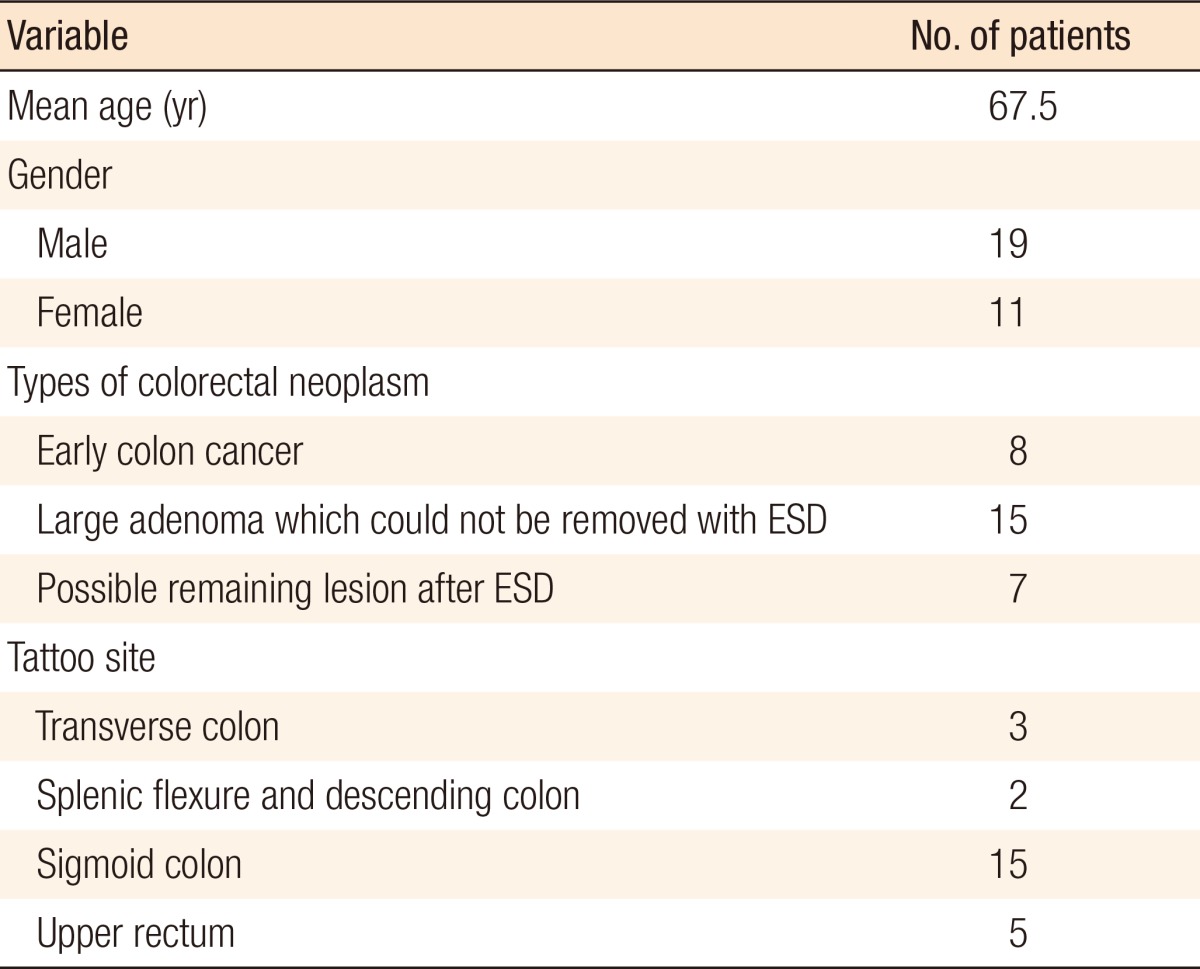
The patients' characteristics are summarized in Table 1. The anatomic distribution of lesions was as follows: transverse colon (n = 3, 12%), splenic flexure and descending colon (n = 2, 8%), sigmoid colon (n = 15, 60%), and upper rectum (n = 5, 20%). In 23 cases (92%), through the laparoscope, we found perfectly localized bloody smudges in the serosa. However, in 2 cases (8%), we could not find the exact location of the lesion. The reasons for failure were an injection that was too deep and an injection that was not deep enough. In the case where the injection was too deep, blood was scattered through the peritoneum adjacent to the affected colon, and in the case where the injection was not deep enough, blood could not penetrate into the serosal layer. There were no complications such as hemorrhage, colonic abscess, or perforation, and none of the patients had clinical symptoms such as fever or abdominal pain after colonoscopy.
In this retrospective study, we found that the localization of a small or invisible lesion by using the patient's bloods was an effective, as well as a safe, method. Preoperative localization of colonic lesions is imperative when the lesions are difficult to find at surgery [7]. Localization of a small, serosa-negative lesion is an important issue particularly when the surgery is performed through the laparoscopy because a laparoscopic or laparoscopy-assisted procedure typically compromises tactile feedback. Recently, localization has become more important because the incidence of endoscopic treatment of cancer-bearing polyps is increasing. The polyp site may heal within 2-4 weeks after removal, so the surgeon will unlikely be able to find such a lesion even in open surgery. Several methods of localization have been tried, and their efficacies have been reported [8]. Measurement of the distance from the anus by using colonoscopy has proven to be an inadequate technique for localization in most cases because colonic redundancy may cause looping of the scope, thereby falsely increasing the distance. Cho et al. [9] reported an 88.7% accuracy rate when using colonoscopic distancing alone.
In 1958, Sauntry and Knudtson [10] first reported the technique of tattooing using blue dye at the base of the polyps. Subsequently, Knoernschild [11] reported on a series of 190 patients who underwent endoscopic tattooing. The most commonly used dye is India ink, as first described in 1975 by Ponsky and King [12]. However, endoscopic tattooing with India ink has been associated with complications or side effects. Dye spillage can make the borders vague, and peritoneal ink may closely resemble endometriosis in women [13]. India ink has also been associated with fat necrosis with inflammatory pseudo-tumor formation, colonic abscess, chronic inflammation, and adhesion formation [14, 15]. Also, fluorescence imaging with light-emitting, iodine-activated ICG has been described [16]. Although this technique is reported to be safe and effective, it will add significant cost because the imaging requires a special light and camera.
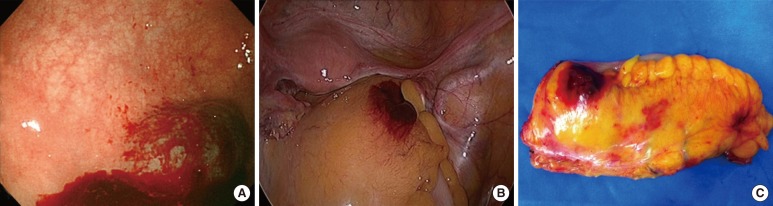
To avoid the side-effects of using India ink, we designed a fascinating method that uses the patient's blood as a tattooing agent. Because the blood is the patient's, no foreign body or inflammatory reactions should occur. As our results showed, only 5 mL of bloods are required to make a well-demarcated intramural tattoo without any pretreatment preparation in Fig. 1. However, our study has limitations. First, experienced endoscopists performed the procedure. They were fully equipped with the benefits of experience reaped from performing hundreds of cases of colonoscopies. They were able to create well-demarcated tattoos without any complications, such as perforations or misdirections. Secondly, our study involved a very small number of patients. Twenty-five cased are not enough to draw any definite conclusions. We think that further investigations using large numbers of patients will be required if our procedure of using a patient's blood as a tattooing agent is to be accepted as a standard technique for the localization of small colonic cancers.
In conclusion, tattooing the colonic wall with the patient's blood is a rapid, accurate, and safe technique for localization of small and invisible lesions in the colon. We think that using the patient's blood is better than using any other foreign material in the creation of colonic tattoos. Further investigations regarding the feasibility of our technique and involving larger numbers of patients are warranted.

No potential conflict of interest relevant to this article was reported.

  • 1. Price N, Gottfried MR, Clary E, Lawson DC, Baillie J, Mergener K, et al. Safety and efficacy of India ink and indocyanine green as colonic tattooing agents. Gastrointest Endosc 2000;51(4 Pt 1): 438–442. ArticlePubMed
  • 2. Coman E, Brandt LJ, Brenner S, Frank M, Sablay B, Bennett B. Fat necrosis and inflammatory pseudotumor due to endoscopic tattooing of the colon with india ink. Gastrointest Endosc 1991;37:65–68. ArticlePubMed
  • 3. Gianom D, Hollinger A, Wirth HP. Intestinal perforation after preoperative colonic tattooing with India ink. Swiss Surg 2003;9:307–310. ArticlePubMed
  • 4. Botoman VA, Pietro M, Thirlby RC. Localization of colonic lesions with endoscopic tattoo. Dis Colon Rectum 1994;37:775–776. ArticlePubMed
  • 5. Bahadursingh AM, Driver M, Koenig CL, Longo WE. Inadvertent transmural India ink tattooing simulating intestinal infarction. Am J Surg 2003;185:88–89. ArticlePubMed
  • 6. Yano H, Okada K, Monden T. Adhesion ileus caused by tattoo-marking: unusual complication after laparoscopic surgery for early colorectal cancer. Dis Colon Rectum 2003;46:987.ArticlePubMed
  • 7. Yeung JM, Maxwell-Armstrong C, Acheson AG. Colonic tattooing in laparoscopic surgery - making the mark? Colorectal Dis 2009;11:527–530. ArticlePubMed
  • 8. Ellis KK, Fennerty MB. Marking and identifying colon lesions. Tattoos, clips, and radiology in imaging the colon. Gastrointest Endosc Clin N Am 1997;7:401–411. ArticlePubMed
  • 9. Cho YB, Lee WY, Yun HR, Lee WS, Yun SH, Chun HK. Tumor localization for laparoscopic colorectal surgery. World J Surg 2007;31:1491–1495. ArticlePubMed
  • 10. Sauntry JP, Knudtson KP. A technique for marking the mucosa of the gastrointestinal tract after polypectomy. Cancer 1958;11:607–610. ArticlePubMed
  • 11. Knoernschild HE. The use of a tattooing instrument for marking colonic mucosa. Am J Surg 1962;103:83–85. ArticlePubMed
  • 12. Ponsky JL, King JF. Endoscopic marking of colonic lesions. Gastrointest Endosc 1975;22:42–43. ArticlePubMed
  • 13. Algoe KK, Chen H, Schned AR, Whiteside JL. Intraperitoneal India ink deposits appearing as endometriosis in a patient with chronic pelvic pain. Obstet Gynecol 2008;112(2 Pt 2): 448–450. ArticlePubMed
  • 14. Nizam R, Siddiqi N, Landas SK, Kaplan DS, Holtzapple PG. Colonic tattooing with India ink: benefits, risks, and alternatives. Am J Gastroenterol 1996;91:1804–1808. PubMed
  • 15. Nagata K, Endo S, Tatsukawa K, Kudo SE. Intraoperative fluoroscopy vs. intraoperative laparoscopic ultrasonography for early colorectal cancer localization in laparoscopic surgery. Surg Endosc 2008;22:379–385. ArticlePubMed
  • 16. Watanabe M, Tsunoda A, Narita K, Kusano M, Miwa M. Colonic tattooing using fluorescence imaging with light-emitting diode-activated indocyanine green: a feasibility study. Surg Today 2009;39:214–218. ArticlePubMed
Fig. 1
(A) Colonoscopic tattoo with the patient's blood. (B) Intraoperative finding of blood tattoo. (C) Specimen finding of blood tattoo.
ac-30-115-g001.jpg
Table 1
Clinicopathologic characteristics of the patients
ac-30-115-i001.jpg

ESD, endoscopic submucosal dissection.

Figure & Data

References

    Citations

    Citations to this article as recorded by  
    • Safety and efficacy of autologous blood tattooing for preoperative colonic localization: a comparative study with conventional India ink tattooing
      Hyeon Kyeong Kim, Ho Seung Kim, Jin Hoon Nam, Bo-Young Oh, Soon Sup Chung, Ryung-Ah Lee, Gyoung Tae Noh
      Techniques in Coloproctology.2024;[Epub]     CrossRef
    • Assessment of Autologous Blood marker localIzation and intraoperative coLonoscopy localIzation in laparoscopic colorecTal cancer surgery (ABILITY): a randomized controlled trial
      Ke-hui Zhang, Jing-ze Li, Hai-bin Zhang, Ren-hao Hu, Xi-mao Cui, Tao Du, Liang Zheng, Shun Zhang, Chun Song, Mei-dong Xu, Xiao-hua Jiang
      BMC Cancer.2023;[Epub]     CrossRef
    • Preoperative tumor marking with indocyanine green (ICG) prior to minimally invasive colorectal cancer: a systematic review of current literature
      Michael K. Konstantinidis, Argyrios Ioannidis, Panteleimon Vassiliu, Nikolaos Arkadopoulos, Ioannis S. Papanikolaou, Konstantinos Stavridis, Gaetano Gallo, Dimitrios Karagiannis, Manish Chand, Steven D. Wexner, Konstantinos Konstantinidis
      Frontiers in Surgery.2023;[Epub]     CrossRef
    • Autologous blood for preoperative colorectal TUMOR's localization: A Vietnamese preliminary experience
      Ngoc Hung Nguyen, The Hiep Nguyen, Cong Long Nguyen, Xuan Vinh Vu, Tuan Hiep Luong, Thanh Khiem Nguyen
      Annals of Medicine & Surgery.2022;[Epub]     CrossRef
    • Preoperative tumor marking with indocyanine green prior of robotic colorectal resections
      Michael K. Konstantinidis, Argyrios Ioannidis, Pantelis Vasiliou, Nikolaos Arkadopoulos, Ioannis S. Papanikolaou, Manish Chand, Tom Pampiglione, Dimitrios Karagiannis, Konstantinos Konstantinidis
      Frontiers in Surgery.2022;[Epub]     CrossRef
    • A Precise Lesion Localization System Using a Magnetometer With Real-Time Baseline Cancellation for Laparoscopic Surgery
      Soon-Jae Kweon, Woojin Yun, Hyunwoo Park, Jeong-Ho Park, Jung Hoon Lee, Jin Lee, Minkyu Je, Sohmyung Ha, Choul-Young Kim
      IEEE Access.2021; 9: 131648.     CrossRef
    • Endoscopic Preoperative Tattooing and Marking in the Gastrointestinal Tract: A Systematic Review of Alternative Methods
      Manuel Barberio, Margherita Pizzicannella, Giovanni Guglielmo Laracca, Mahdi Al-Taher, Andrea Spota, Jacques Marescaux, Eric Felli, Michele Diana
      Journal of Laparoendoscopic & Advanced Surgical Techniques.2020; 30(9): 953.     CrossRef
    • The Usefulness of Preoperative Colonoscopic Tattooing with Autologous Blood for Localization in Laparoscopic Colorectal Surgery
      Ui Do Yeo, Nak Song Sung, Seung Jae Roh, Won Jun Choi, Kyung Ho Song, In Seok Choi, Dae Sung Yoon, Sang Eok Lee, Ju Ik Moon, Seong Uk Kwon, In Eui Bae, Seung Jae Lee
      The Journal of Minimally Invasive Surgery.2020; 23(3): 114.     CrossRef
    • Preoperative Colonoscopic Tattooing with Autologous Blood in Laparoscopic Colorectal Cancer Surgery: Red-Flagging for an Invisible Enemy
      Jeehye Lee, Heung-Kwon Oh
      The Journal of Minimally Invasive Surgery.2020; 23(3): 110.     CrossRef
    • Autologous blood, a novel agent for preoperative colonic localization: a safety and efficacy comparison study
      Eui Joo Kim, Jun-Won Chung, Su Young Kim, Jung Ho Kim, Yoon Jae Kim, Kyoung Oh Kim, Kwang An Kwon, Dong Kyun Park, Duck Joo Choi, Sung Won Park, Jeong-Heum Baek, Won-Suk Lee
      Surgical Endoscopy.2019; 33(4): 1080.     CrossRef
    • Preoperative Tattooing Using Indocyanine Green in Laparoscopic Colorectal Surgery
      Sang Jae Lee, Dae Kyung Sohn, Kyung Su Han, Byung Chang Kim, Chang Won Hong, Sung Chan Park, Min Jung Kim, Byung Kwan Park, Jae Hwan Oh
      Annals of Coloproctology.2018; 34(4): 206.     CrossRef
    • Preoperative localization of colorectal cancer: a systematic review and meta-analysis
      Sergio A. Acuna, Maryam Elmi, Prakesh S. Shah, Natalie G. Coburn, Fayez A. Quereshy
      Surgical Endoscopy.2017; 31(6): 2366.     CrossRef
    • Colonoscopic Tattooing of Colonic Lesions
      Jae Hyun Kim, Won Ho Kim
      The Korean Journal of Gastroenterology.2015; 66(4): 190.     CrossRef
    • Efficacy of a Patient's Own Blood as Colonic Localization Agent
      Dae Youn Won, Won-Kyung Kang
      Annals of Coloproctology.2014; 30(3): 101.     CrossRef

    • Cite this Article
      Cite this Article
      export Copy Download
      Close
      Download Citation
      Download a citation file in RIS format that can be imported by all major citation management software, including EndNote, ProCite, RefWorks, and Reference Manager.

      Format:
      • RIS — For EndNote, ProCite, RefWorks, and most other reference management software
      • BibTeX — For JabRef, BibDesk, and other BibTeX-specific software
      Include:
      • Citation for the content below
      Preoperative Localization of Early Colorectal Cancer or a Malignant Polyp by Using the Patient's Own Blood
      Ann Coloproctol. 2014;30(3):115-117.   Published online June 23, 2014
      Close
    • XML DownloadXML Download
    Figure
    • 0
    Preoperative Localization of Early Colorectal Cancer or a Malignant Polyp by Using the Patient's Own Blood
    Image
    Fig. 1 (A) Colonoscopic tattoo with the patient's blood. (B) Intraoperative finding of blood tattoo. (C) Specimen finding of blood tattoo.
    Preoperative Localization of Early Colorectal Cancer or a Malignant Polyp by Using the Patient's Own Blood

    Clinicopathologic characteristics of the patients

    ESD, endoscopic submucosal dissection.

    Table 1 Clinicopathologic characteristics of the patients

    ESD, endoscopic submucosal dissection.


    Ann Coloproctol : Annals of Coloproctology Twitter Facebook
    TOP