
Warning: fopen(/home/virtual/colon/journal/upload/ip_log/ip_log_2025-11.txt): failed to open stream: Permission denied in /home/virtual/lib/view_data.php on line 95 Warning: fwrite() expects parameter 1 to be resource, boolean given in /home/virtual/lib/view_data.php on line 96 Incidence and Risk Factors of Parastomal Hernia
Skip Navigation
Skip to contents

Ann Coloproctol : Annals of Coloproctology

OPEN ACCESS
SEARCH
Search

Articles

Page Path
HOME > J Korean Soc Coloproctol > Volume 28(5); 2012 > Article
Original Article
Incidence and Risk Factors of Parastomal Hernia
Yeun Ju Sohn, Sun Mi Moon, Ui Sup Shin, Sun Hee Jee
Journal of the Korean Society of Coloproctology 2012;28(5):241-246.
DOI: https://doi.org/10.3393/jksc.2012.28.5.241
Published online: October 31, 2012

Department of Surgery, Korea Cancer Center Hospital, Korea Institute of Radiological & Medical Sciences, Seoul, Korea.

Correspondence to: Sun Mi Moon, M.D. Department of Surgery, Korea Cancer Center Hospital, Korea Institute of Radiological & Medical Sciences, 75 Nowon-ro, Nowon-gu, Seoul 139-706, Korea. Tel: +82-2-970-1237, Fax: +82-2-970-2419, msm386@yahoo.co.kr
• Received: August 31, 2012   • Accepted: October 7, 2012

© 2012 The Korean Society of Coloproctology

This is an open-access article distributed under the terms of the Creative Commons Attribution Non-Commercial License (http://creativecommons.org/licenses/by-nc/3.0) which permits unrestricted non-commercial use, distribution, and reproduction in any medium, provided the original work is properly cited.

prev next
  • 7,419 Views
  • 65 Download
  • 60 Crossref
  • 68 Scopus
  • Purpose
    Among the various stoma complications, the parastomal hernia (PSH) is the most common. Prevention of PSH is very important to improve the quality of life and to prevent further serious complications. The aim of this study was to analyze the incidence and the risk factors of PSH.
  • Methods
    From January 2002 and October 2008, we retrospectively reviewed 165 patients who underwent an end colostomy. As a routine oncologic follow-up, abdomino-pelvic computed tomography was used to examine the occurrence of the PSH. The associations of age, sex, body mass index (BMI), history of steroid use and comorbidities to the development of the PSH were analyzed. The median duration of the follow-up was 36 months (0 to 99 months).
  • Results
    During follow-up, 50 patients developed a PSH and the 5-year cumulative incidence rate of a PSH, obtained by using the Kaplan-Meier method, was 37.8%. In the multivariate COX analysis, female gender (hazard ratio [HR], 3.29; 95% confidence interval [CI], 1.77 to 6.11; P < 0.0001), age over 60 years (HR, 2.37; 95% CI, 1.26 to 4.46; P = 0.01), BMI more than 25 kg/m2 (HR, 1.8; 95% CI, 1.02 to 3.16; P = 0.04), and hypertension (HR, 2.08; 95% CI, 1.14 to 3.81; P = 0.02) were all independent risk factors for the development of a PSH.
  • Conclusion
    The 5-year incidence rate of a PSH was 37.8%. The significant risk factors of a PSH were as follows: female gender, age over 60 years, BMI more than 25 kg/m2, and hypertension. Using a prophylactic mesh during colostomy formation might be advisable when the patients have these factors.
Many stoma-related complications, such as parastomal hernias (PSHs), prolapses, stenosis, skin rashes, and problems of adaptation, exist. Among them, the PSH is the most common [1-3]. The prevalence of a PSH ranges widely according to the follow-up time [4] and the type of colostomy. In the end colostomy, it varies from 4 to 50% [5], and in the loop colostomy, between 0% and 30.8% was reported [6]. Although, many PSHs are asymptomatic, they may create problems ranging from discomfort to life-threatening complications, such as perforation, occlusion, or strangulation [7]. As PSH repair techniques, local tissue repair, stoma relocation, and mesh repair have been used. However, the results of PSH repair have been disappointing, with reported recurrence rates of 30 to 76% after local aponeurotic repair, stoma relocation, and laparoscopic repair [8-15]. Due to the frequency of PSHs and the limited success of repair, attention has been focused on preventing PSHs at the outset when a stoma is fashioned. Recently, mesh reinforcement at the time of stoma formation has further decreased the incidence of PSHs [16, 17]. However, mesh insertion may also present potential complications in the form of adhesions and intestinal obstruction. Therefore, it is not suitable for all patients of colostomy [18]. For this reason, we conducted this retrospective study to investigate the annual incidence of PSHs and the risk factors for development of a PSH in order to select patients who would most benefit from prophylactic mesh insertion.
Between January 2002 and October 2008, we collected 165 consecutive patients who underwent end-colostomy formation after resection of malignancies located in the distal colon or rectum without a history of previous laparotomy at the Korea Cancer Center Hospital. All end-colostomies were formed at an intra-operatively-calibrated site through the rectus muscle in a trans-peritoneal manner under open surgical fields. Clinical data, age at the time of stoma creation, sex, comorbidities, uses of steroids as premedication for chemotherapy, body mass index (BMI, kg/m2), and indication of colostomy, were all retrieved from a computerized database and medical records. Differences in frequency of those clinical variables were checked between the groups with a PSH (PSH+ group) and without a PSH (PSH- group). This study was approved by our Institutional Review Board for Human Research.
To check the development of the PSH, we assessed the results from abdomino-pelvic computed tomography (APCT), which was performed every 6 to 12 months for oncologic follow-up. A PSH was defined as a protrusion of any abdominal content other than the stomal loop through a widened opening of posterior rectus sheaths at APCT.
To calculate the cumulative annual incidence rate of PSHs, we used the Kaplan-Meier estimate analysis. The follow-up period was calculated from the date of stoma formation to the date of PSH detection or to the last date of the practice of APCT in patients with no PSH. To compare the cumulative incidence rate according to the clinical variables, we performed log rank tests. To investigate the contribution of clinical factors, such as age, sex, comorbidities, uses of steroids as premedication for chemotherapy, BMI, to the development of the PSH, we used the uni- and multivariate Cox proportional hazard model and the backward stepwise elimination method. All variables considered in regression models were reported with hazard ratios (HRs) and 95% confidence intervals (CIs). All statistical analyses were performed using SPSS ver. 14.0 (SPSS Inc., Chicago, IL, USA). Differences between the groups were assessed by using the chi-square test and the Fisher's exact test for categorical variable and the independent sample t-test for continuous variables. A P-value of < 0.05 was considered statistically significant.
The mean age of all patients was 57.3 years (standard deviation [SD], 10.8 years), and males (58.8%) were predominant. All patients had neoplastic primary disease. One hundred fifty-nine patients (96.4%) had colorectal cancer, 3 patients (1.8%) had anal cancer, and the other 3 patients had, respectively, a gastrointestinal stromal tumor (0.6%), a malignant melanoma (0.6%), and ovarian cancer (0.6%). An end-colostomy was formed in 159 cases after abdomino-perineal resection (96.4%) and in 6 cases after a Hartmann's operation (3.6%).
During an overall median follow-up of 36 months (range, 1 to 99 months), 50 patients (30.3%) developed a PSH after a median of 14 months (range, 1 to 60 months) from the date of stoma formation. Six patients with a PSH (12.0%) had hernia-related symptoms; four patients complained of subcutaneous bulging around the stoma, 1 patient had a stomal prolapse, and the other patient had symptoms of bowel obstruction. Including patients with bowel obstruction and stomal prolapse, five patients received a hernia repair; four patients received local tissue repair, and one patient received mesh reinforcement. However, the PSH reappeared in four patients after hernia repair.
When the clinical variables were compared according to the presence of a PSH, the mean age and the frequency of age more than 60 years were significantly higher in the PSH+ group (70.0% vs. 36.5%, P < 0.0001). Also, female gender was significantly more frequent in the PSH+ group (70.0% vs. 28.7%, P < 0.0001). The mean value of the BMI of the PSH+ group was 25.0 kg/m2 (SD, 3.0), which was significantly higher than that of the PSH- group (mean, 23.2 kg/m2; SD, 2.9; P < 0.0001). The frequency of hypertension in the PSH+ group was significantly higher (36.0% vs. 19.1%, P = 0.03). The distribution of primary disease, as well as the frequencies of comorbidities such as chronic liver disease, chronic lung disease, cardiovascular disease, and diabetes mellitus, was similar between the groups. Steroid use for premedication for chemotherapy was not significantly associated with the presentation of a PSH (Table 1).
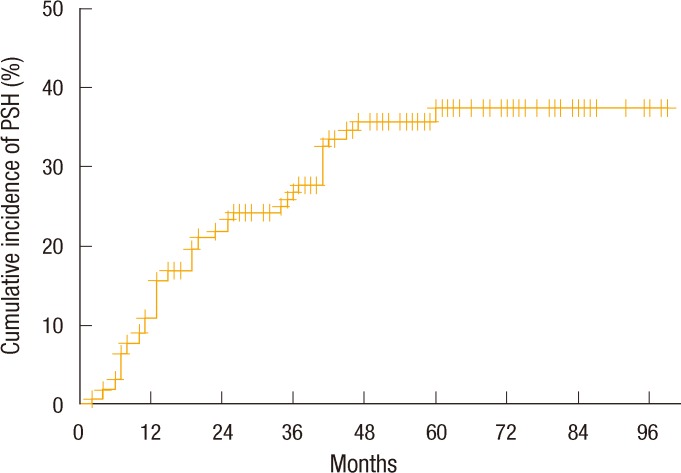
A Kaplan-Meier analysis showed that the annual cumulative incidence rates of PSH were 10.9% at 1 year, 21.7% at 2 years, 26.4% at 3 years, 35.6% at 4 years, and 37.3% at 5 years. However, no further development of a PSH was noted for follow-up periods of more than 5 years (Fig. 1). When the 5-year cumulative incidence rates of PSH were compared according to clinical variables, female patients showed a significantly higher incidence rate than male patients (59.5% vs. 17.9%, P < 0.0001). Also, the PSH incidence rate of patients aged more than 60 years was significantly higher than that younger patients (57.1% vs. 27.5%, P < 0.0001). The 5-year cumulative incidence rate of patients with a BMI of more than 25 kg/m2 was 51.9%, which was significantly higher than that of patients with a BMI of under 25 kg/m2 (29.6%, P = 0.009). Further, patients with hypertension showed a significantly higher incidence rate of PSH (51.9% vs. 29.6%, P = 0.002) (Fig. 2).
In the multivariate analysis, female gender (HR, 3.29; 95% CI, 1.77 to 6.11; P < 0.0001), age more than 60 years (HR, 2.37; 95% CI, 1.26 to 4.46; P = 0.01), BMI of more than 25 kg/m2 (HR, 1.8; 95% CI, 1.02 to 3.16; P = 0.04), and hypertension (HR, 2.08; 95% CI, 1.14 to 3.81; P = 0.02) were independent risk factors for the development of a PSH. Other factors, such as use of steroids, chronic liver disease, chronic pulmonary disease, and diabetes mellitus, were not associated with the development of a PSH (Table 2).
Although, the PSH is the most frequent complication among the various stoma-related problems according to many reports [1-3], the true rate of PSHs has been very difficult to estimate. In an end colostomy, the prevalence of PSHs has a very wide range from 4 to 50% [5]. The reason for the range of the PSH incidence rate being so wide is the lack of a consistent definition of a PSH. A PSH is a kind of incisional hernia related to an abdominal wall stoma [5]. In some clinical reports, a PSH was defined as a palpable defect or a bulge adjacent to the stoma [4, 19, 20]. In another study, herniation was defined as a palpable "cough impulse" at the ostomy site [15]. In another study, a CT scan result was added to a radiological definition of any intraabdominal content protruding along the ostomy [17, 21]. The use of CT scans may have contributed to the high hernia rates reported during the last decade, as they allow the detection of small PSHs [15, 21, 22]. Indeed, the estimated PSH incidence rate of our study, using a definition of PSH by CT scan, was 37.8% at 5 years, which was relatively higher than those in other studies using a clinical definition of a PSH [4, 20]. Diagnosis via a CT scan, due to its higher sensitivity, may result in a diagnosis of asymptomatic and clinically insignificant PSHs [23]. However, to compare the prevalence between studies and to obtain objective information, we believe a CT scan will be a better alternative because it defines the PSH with greater precision than can be achieved using only a clinical diagnosis. A recent study showed significant differences for clinical diagnoses among various experienced examiners on the same surgical service [24].
Another important factor to estimate the true PSH rate is the follow-up time after stoma creation. Similar to a ventral incisional hernia, reports regarding this incidence of PSHs, with a life-table analysis, showed an increasing rate of PSHs with increasing follow-up time [4, 25]. Our population also showed an increasing rate of PSHs with increasing follow-up time. In a comprehensive review in 2008 [26], the follow-up times were seen to vary considerably in clinical reports, and only a few studies had followed patients for at least 1 year or longer. In this review, reported PSH rates were 11 to 50%. Because of the inconsistent definition of a PSH, the variable follow-up period after the index operation in the reported cases also makes it difficult to compare rates of PSHs between different series and to estimate a true rate of PSHs, but the rate is most likely between 30% and 50% in general surgical practice. In this study, the cumulative incidence rate of PSHs increased annually to 37.8% after 5 years. However, after a 5-year follow-up, we did not observe any further occurrence of a PSH. The reason the incidence of PSHs after 5 years showed a plateau is uncertain. However, we assumed that all stomas enrolled in this study were created after surgeries for neoplastic disease and that the majority of them were colorectal cancer. Thus, the follow-up may be restricted by patients' deaths due to disease progression. Thus, when assessing and comparing the PSH incidence rate with long-term follow-up, we should consider whether the primary diseases are benign or malignant.
The PSH has been treated conservatively in most patients. Surgical repair is indicated in 15 to 20% of symptomatic PSH patients with a stoma that is difficult to manipulate, obstruction, bowel incarceration and perforation. As for PSH repair techniques, local tissue repair, stoma relocation, and mesh repair have been used. However, the results of PSH repair have been disappointing, with reported recurrence rates of 30 to 76% after local aponeurotic repair, stoma relocation, and laparoscopic repair [8-15]. Because of the high frequency of PSHs and the high recurrence rate of PSHs after repair, attention has been focused on preventing theirs appearance from the very beginning, i.e., at the time of stoma creation.
A recent issue concerning PSH prevention during the primary surgical procedure has been prosthetic mesh reinforcement around the stoma. One randomized controlled trial was aborted early because it was considered unethical to continue; half of the patients in the control arm had developed a PSH compared to only 1 of 21 in the study group [21]. Several other studies reported similar results of a decreased occurrence rate of PSHs [16, 17]. However, reported rates of complications related to mesh insertion were extremely low [27]. Despite those promising results, many surgeons are probably hesitant to use prosthetic mesh because of the theoretical risk of infection from mesh placement in a contaminated environment. Also, mesh insertion is a time-consuming procedure. Therefore, a necessity exists to select patients by assessing the risk factors related to the development of the PSH and by identifying those patients that would benefit most from this technique.
The risk of occurrence of PSHs is related, in part, to the clinical characteristics of the patient and to the surgical technique employed in stoma formation. In regards to the patient-related risk factors, most authors consider them to be identical to those for any incisional hernia, namely, obesity, malnutrition, increased abdominal pressure, corticosteroid use, and advanced age. Some studies have shown that the incidence of other abdominal wall hernias is increased in patients with a PSH and that a previous history of incisional hernia is related to the development of a PSH [20]. This suggests that a possible overall weakening of the anterior abdominal wall musculoaponeurotic configuration contributes to the PSH. In this study, we investigated the clinical risk factors of age more than 60 years, sex, obesity with a BMI of more than 25 kg/m2, hypertension, cardiovascular disease, chronic lung disease, chronic liver disease, history of corticosteroids use as premedication for chemotherapy, and diabetes mellitus. Among them, age more than 60 years, female gender, a BMI of more than 25 kg/m2, and hypertension were significantly associated with a high incidence rate of PSHs in the multivariate Cox analysis. However, the scientific evidence supporting this is limited, and much of the evidence relies on the studies carried out on other forms of hernia development or on anecdotal evidence of clinicians involved in the care of the patients undergoing stoma formation. As patients get older, the muscles in the abdomen weaken, and if the abdominal muscles do not strengthen, the abdomen may be unable to provide adequate support for a stoma. A retrospective review of 782 patients with a follow-up period of more than 10 years suggested that PSHs are more likely to occur in the elderly [20], and another study reported that age was a significant factor in the development of a hernia, especially in the group of age over 60 [4]. This may be due to the fact that with age, the thickness of the rectus abdominis muscle reduces; thus, the layer of subcutaneous fat increases [28]. In addition to old age, female gender was also an independent risk factor for the occurrence of a PSH in this study. Considering the fact that women have thinner muscles and thicker fat than men regardless of age [28], this physiological difference may contribute to women's vulnerability to PSHs.
Obesity has been a traditional risk factor for incisional hernias and PSHs. Some authors argued that obesity as defined by the waist circumference was significantly associated with a PSH because of increased radial force, i.e., intraabdominal pressure [23, 29]. Also, obesity causes susceptibility to wound infection, which contributes to the incisional hernia or PSH [30]. In this regard, safety might be a major concern for prophylactic mesh insertion in obese patients due to its relation to mesh infection. In this study, obesity was defined by using a BMI of more than 25 kg/m2, and that was a significant risk factor for the occurrence of a PSH, as in other studies.
Until now, according to postoperative morbidity reports after mesh insertion for the prevention of PSHs, there were nearly no complications, such as peristomal infection, that affected mesh intolerance or chronic infection [16, 17]. However, the number of patients enrolled in those studies was so small that caution should be used when drawing any concrete conclusions on the safety of prophylactic mesh insertion in these obese patients. Thus, a large-scaled trial is strongly needed. Finding or assuming a scientific relation between hypertension, a significant risk factor for a PSH in this study, and the development a PSH is very difficult. That relation might be associated with age and obesity, considering the fact that as patients get older and are more obese, the incidence of hypertension increases.
In conclusion, in our study, the incidence of PSH increased annually and reached 37.8% at 5 years. The female gender, age more than 60 years, and BMI of more than 25 kg/m2 were found to have independent significant associations with the development of PSH. If the safety of the prophylactic mesh insertion can be guaranteed through future, large, randomized trial, patients with these risk factors may benefit from this procedure.

No potential conflict of interest relevant to this article was reported.

  • 1. Bass EM, Del Pino A, Tan A, Pearl RK, Orsay CP, Abcarian H. Does preoperative stoma marking and education by the enterostomal therapist affect outcome? Dis Colon Rectum 1997;40:440–442. ArticlePubMed
  • 2. Arumugam PJ, Bevan L, Macdonald L, Watkins AJ, Morgan AR, Beynon J, et al. A prospective audit of stomas: analysis of risk factors and complications and their management. Colorectal Dis 2003;5:49–52. ArticlePubMed
  • 3. Park JJ, Del Pino A, Orsay CP, Nelson RL, Pearl RK, Cintron JR, et al. Stoma complications: the Cook County Hospital experience. Dis Colon Rectum 1999;42:1575–1580. ArticlePubMed
  • 4. Mylonakis E, Scarpa M, Barollo M, Yarnoz C, Keighley MR. Life table analysis of hernia following end colostomy construction. Colorectal Dis 2001;3:334–337. ArticlePubMed
  • 5. Pearl RK. Parastomal hernias. World J Surg 1989;13:569–572. ArticlePubMed
  • 6. Carne PW, Robertson GM, Frizelle FA. Parastomal hernia. Br J Surg 2003;90:784–793. ArticlePubMed
  • 7. Goligher JC, Lloyd-Davies OV, Robertson CT. Small-gut obstructions following combined excision of the rectum with special reference to strangulation round the colostomy. Br J Surg 1951;38:467–473. ArticlePubMed
  • 8. Hansson BM, Bleichrodt RP, de Hingh IH. Laparoscopic parastomal hernia repair using a keyhole technique results in a high recurrence rate. Surg Endosc 2009;23:1456–1459. ArticlePubMed
  • 9. Amin SN, Armitage NC, Abercrombie JF, Scholefield JH. Lateral repair of parastomal hernia. Ann R Coll Surg Engl 2001;83:206–208. PubMedPMC
  • 10. Burns FJ. Complications of colostomy. Dis Colon Rectum 1970;13:448–450. ArticlePubMed
  • 11. Kronborg O, Kramhoft J, Backer O, Sprechler M. Late complications following operations for cancer of the rectum and anus. Dis Colon Rectum 1974;17:750–753. ArticlePubMed
  • 12. Martin L, Foster G. Parastomal hernia. Ann R Coll Surg Engl 1996;78:81–84. PubMedPMC
  • 13. Rubin MS, Schoetz DJ Jr, Matthews JB. Parastomal hernia. Is stoma relocation superior to fascial repair? Arch Surg 1994;129:413–418. ArticlePubMed
  • 14. Sjodahl R, Anderberg B, Bolin T. Parastomal hernia in relation to site of the abdominal stoma. Br J Surg 1988;75:339–341. ArticlePubMed
  • 15. Williams JG, Etherington R, Hayward MW, Hughes LE. Paraileostomy hernia: a clinical and radiological study. Br J Surg 1990;77:1355–1357. ArticlePubMed
  • 16. Hammond TM, Huang A, Prosser K, Frye JN, Williams NS. Parastomal hernia prevention using a novel collagen implant: a randomised controlled phase 1 study. Hernia 2008;12:475–481. ArticlePubMed
  • 17. Serra-Aracil X, Bombardo-Junca J, Moreno-Matias J, Darnell A, Mora-Lopez L, Alcantara-Moral M, et al. Randomized, controlled, prospective trial of the use of a mesh to prevent parastomal hernia. Ann Surg 2009;249:583–587. ArticlePubMed
  • 18. Morris-Stiff G, Hughes LE. The continuing challenge of parastomal hernia: failure of a novel polypropylene mesh repair. Ann R Coll Surg Engl 1998;80:184–187. PubMedPMC
  • 19. Ripoche J, Basurko C, Fabbro-Perray P, Prudhomme M. Parastomal hernia. A study of the French federation of ostomy patients. J Visc Surg 2011;148:e435–e441. ArticlePubMed
  • 20. Janes A, Cengiz Y, Israelsson LA. Preventing parastomal hernia with a prosthetic mesh. Arch Surg 2004;139:1356–1358. ArticlePubMed
  • 21. Cingi A, Cakir T, Sever A, Aktan AO. Enterostomy site hernias: a clinical and computerized tomographic evaluation. Dis Colon Rectum 2006;49:1559–1563. ArticlePubMed
  • 22. De Raet J, Delvaux G, Haentjens P, Van Nieuwenhove Y. Waist circumference is an independent risk factor for the development of parastomal hernia after permanent colostomy. Dis Colon Rectum 2008;51:1806–1809. ArticlePubMed
  • 23. Moreno-Matias J, Serra-Aracil X, Darnell-Martin A, Bombardo-Junca J, Mora-Lopez L, Alcantara-Moral M, et al. The prevalence of parastomal hernia after formation of an end colostomy: a new clinico-radiological classification. Colorectal Dis 2009;11:173–177. ArticlePubMed
  • 24. Gurmu A, Matthiessen P, Nilsson S, Pahlman L, Rutegard J, Gunnarsson U. The inter-observer reliability is very low at clinical examination of parastomal hernia. Int J Colorectal Dis 2011;26:89–95. ArticlePubMed
  • 25. Hoer J, Lawong G, Klinge U, Schumpelick V. Factors influencing the development of incisional hernia: a retrospective study of 2,983 laparotomy patients over a period of 10 years. Chirurg 2002;73:474–480. ArticlePubMed
  • 26. Israelsson LA. Parastomal hernias. Surg Clin North Am 2008;88:113–125. ix.ArticlePubMed
  • 27. Wijeyekoon SP, Gurusamy K, El-Gendy K, Chan CL. Prevention of parastomal herniation with biologic/composite prosthetic mesh: a systematic review and meta-analysis of randomized controlled trials. J Am Coll Surg 2010;211:637–645. ArticlePubMed
  • 28. Kanehisa H, Miyatani M, Azuma K, Kuno S, Fukunaga T. Influences of age and sex on abdominal muscle and subcutaneous fat thickness. Eur J Appl Physiol 2004;91:534–537. ArticlePubMed
  • 29. de Ruiter P, Bijnen AB. Successful local repair of paracolostomy hernia with a newly developed prosthetic device. Int J Colorectal Dis 1992;7:132–134. ArticlePubMed
  • 30. Israelsson LA, Jonsson T. Overweight and healing of midline incisions: the importance of suture technique. Eur J Surg 1997;163:175–180. PubMed
Fig. 1
Cumulative incidence rate of a parastomal hernia (PSH) in all patients.
jksc-28-241-g001.jpg
Fig. 2
Cumulative incidence rate of a parastomal hernia (PSH) according to sex, age, body mass index (BMI) and hypertension.
jksc-28-241-g002.jpg
Table 1
Patients characteristics
jksc-28-241-i001.jpg

Values are presented as mean ± SD or number (%).

PSH, parastomal hernia.

Table 2
Factors associated with the occurrences of a parastomal hernia
jksc-28-241-i002.jpg

HR, hazard ratio; CI, confidence interval; BMI, body mass index.

Figure & Data

References

    Citations

    Citations to this article as recorded by  
    • Long-term outcomes after open parastomal hernia repair at a high-volume center
      Alexis M. Holland, William R. Lorenz, Brittany S. Mead, Gregory T. Scarola, Vedra A. Augenstein, B. Todd Heniford, Monica E. Polcz
      Surgical Endoscopy.2025; 39(1): 639.     CrossRef
    • Outcomes after surgical repair of primary parastomal hernia
      Nulvin Djebbara-Bozo, Nellie B. Zinther, Anette Søgaard, Hans Friis-Andersen
      Hernia.2025;[Epub]     CrossRef
    • Rectus abdominis muscle atrophy, prophylactic mesh, and stoma placement: retrospective findings from a prospective multicenter trial
      Staffan Täckström, Eva Angenete, Rode Grönkvist, Eva Haglind, Peter Kälebo, Adiela Correa Marinez, Jacob Rosenberg, Maziar Nikberg
      Hernia.2025;[Epub]     CrossRef
    • Sandwich parastomal hernia repair, a prospective observational study
      T. B. Johnsen, T. Stornes, B. Ystgaard, T. E. Bernstein
      Hernia.2025;[Epub]     CrossRef
    • Incidence, Risk Factors, and Prediction Model of Parastomal Hernia After Abdominoperineal Resection for Rectal Cancer
      Jiyun Li, Jichuan Quan, Zixing Zhu, Dedi Jiang, Zhixun Zhao, Mingguang Zhang, Jianjun Bi, Qiang Feng, Zheng Wang, Haitao Zhou, Wei Pei, Qian Liu, Zhaoxu Zheng, Minjie Wang, Jianwei Liang
      World Journal of Surgery.2025;[Epub]     CrossRef
    • Effectiveness of prophylactic three-dimensional mesh in preventing parastomal hernia in patients undergoing permanent end colostomy formation for rectal cancer: a systematic review
      Anies Sebastian, Felicity Hasson, Sinead Keeney
      European Surgery.2025;[Epub]     CrossRef
    • Development and validation of a nomogram prediction model for the risk of parastomal hernia
      Huasheng Liu, Weiqin Wang, Chen Qin, Hongxia Wang, Wei Qi, Yanhua Wei, Longbo Zheng, Jilin Hu
      Intelligent Medicine.2024; 4(2): 128.     CrossRef
    • Modified Approach for Extraperitoneal Colostomy Creation in Laparoscopic Abdominoperineal Resection
      Xiang Zhang, Xin Li, Zhiqiang Cheng, Kexin Wang, Yong Dai, Yanlei Wang
      Diseases of the Colon & Rectum.2024; 67(2): 333.     CrossRef
    • The clinical applications of D-type parastomal hernia repair surgery
      Y. Y. Fu, Y. Ma, C. K. Zhang, L. H. Sun, D. Tang, W. Wang, D. R. Wang
      Hernia.2024; 28(2): 427.     CrossRef
    • Comparison of the 3-D mesh and Sugarbaker repair for parastomal hernia: a single center experience in China
      Hekai Shi, Shaochun Li, Yiming Lin, Dongchao Yang, Wenpei Dong, Zhicheng Song, Heng Song, Yan Gu
      Updates in Surgery.2024; 76(5): 1991.     CrossRef
    • Evaluating EHS parastomal hernia classification for surgical planning: a retrospective analysis of 160 consecutive cases in a single center
      Marek Szczepkowski, Mateusz Zamkowski, Suwała Alicja, Witkowski Piotr, Maciej Śmietański
      Hernia.2024; 28(5): 1915.     CrossRef
    • Lap-re-Do Keyhole versus Lap-re-Do Sugarbaker techniques in large parastomal hernia repair: a retrospective cohort study
      Xiaojian Fu, Minglei Li, Rong Hua, Qiyuan Yao
      Hernia.2024; 28(5): 1945.     CrossRef
    • Risk factors for parastomal hernia after abdominoperineal resection of rectal cancer
      Lele Zhu, Shun Li, Feitong Wang
      Frontiers in Oncology.2024;[Epub]     CrossRef
    • Oncological outcome following Hartmann's procedure compared with anterior resection and abdominoperineal resection for rectal cancer—The type of procedure does not influence local recurrence or distant metastasis: A population‐based study
      Dieter Hahnloser
      Colorectal Disease.2024; 26(10): 1794.     CrossRef
    • A giant parastomal hernia in a high risk patient: preparation to make surgery worthwhile
      Seda Gunes, Ali Bohlok, Antoine El Asmar, Thibaut Engels, Marie Magdelaine Lefort, Eleonora Farinella, Issam El Nakadi
      Acta Chirurgica Belgica.2023; 123(3): 309.     CrossRef
    • Sugarbaker Versus Keyhole Repair for Parastomal Hernia: a Systematic Review and Meta-analysis of Comparative Studies
      Andrew M. Fleming, Alisa L. Phillips, Justin A. Drake, Megan G. Gross, Danny Yakoub, Justin Monroe, Nathan M. Hinkle, David Shibata, Elizabeth H. Wood
      Journal of Gastrointestinal Surgery.2023; 27(3): 573.     CrossRef
    • Contemporary Outcomes of Elective Parastomal Hernia Repair in Older Adults
      Ryan Howard, Farizah Rob, Jyothi Thumma, Anne Ehlers, Sean O’Neill, Justin B. Dimick, Dana A. Telem
      JAMA Surgery.2023; 158(4): 394.     CrossRef
    • The Risk Factors for Parastomal Hernia Development: A 8-year Retrospective Study in Colorectal Surgery
      Tayfun BİŞGİN, Cahide AYİK, Deniz CENAN, Berke MANOĞLU, Dilek ÖZDEN, Selman SÖKMEN
      Journal of Basic and Clinical Health Sciences.2023; 7(2): 773.     CrossRef
    • 67/w mit Vorwölbung um das Stoma
      F. Köhler, Michael Meir
      Die Chirurgie.2023; 94(S1): 35.     CrossRef
    • Effect of Obesity Classification on Complications after Sigmoidostomy for Low-Grade Rectal Cancer: A Retrospective Cohort Study
      慧 王
      Advances in Clinical Medicine.2023; 13(07): 11825.     CrossRef
    • Risk Factors for the Development of Parastomal Hernia: A Narrative Review
      Teodora Elena Manole, Ion Daniel, Bolocan Alexandra, Păduraru N. Dan, Octavian Andronic
      Saudi Journal of Medicine & Medical Sciences.2023; 11(3): 187.     CrossRef
    • Prophylactic retromuscular mesh placement for parastomal hernia prevention: a retrospective cohort study of permanent colostomies and ileostomies
      Jonathan Frigault, Simon Lemieux, Dominic Breton, Philippe Bouchard, Alexandre Bouchard, Roger C. Grégoire, François Letarte, Gilles Bouchard, Vincent Boun, Katia Massé, Sébastien Drolet
      Hernia.2022; 26(2): 495.     CrossRef
    • Stoma creation is associated with a low incidence of midline incisional hernia after colorectal surgery: the “fighting over the fascia” theory concerning the incision and stoma hole
      Noriaki Ohara, Kay Uehara, Atsushi Ogura, Masanori Sando, Toshisada Aiba, Yuki Murata, Takashi Mizuno, Kokuryo Toshio, Yukihiro Yokoyama, Satoko Ishigaki, Yuanying Li, Hiroshi Yatsuya, Tomoki Ebata
      Surgery Today.2022; 52(6): 953.     CrossRef
    • Risk factors for the development of a parastomal hernia in patients with enterostomy: a systematic review and meta-analysis
      Niu Niu, Shizheng Du, Dongliang Yang, Liuliu Zhang, Bainv Wu, Xiaoxu Zhi, Jun Li, Dejing Xu, Yinan Zhang, Aifeng Meng
      International Journal of Colorectal Disease.2022; 37(3): 507.     CrossRef
    • An Analysis of the Risk Factors for the Development of Parastomal Hernia: A Single Institutional Experience
      Faiza H Soomro, Sufyan Azam, Sritharan Ganeshmoorthy, Peter Waterland
      Cureus.2022;[Epub]     CrossRef
    • Is absorbable mesh useful in preventing parastomal hernia after emergency surgery? The PARTHENOPE study
      F. Pizza, D. D’Antonio, F. S. Lucido, P. Del Rio, C. Dell’Isola, L. Brusciano, S. Tolone, L. Docimo, C. Gambardella
      Hernia.2022; 26(2): 507.     CrossRef
    • Comparison of the extraperitoneal and transperitoneal routes for permanent colostomy: a meta-analysis with RCTs and systematic review
      Jinlong Luo, Dujanand Singh, Faqiang Zhang, Xinting Yang, Xiaoying Zha, Huaiwu Jiang, Lie Yang, Hua Yang
      World Journal of Surgical Oncology.2022;[Epub]     CrossRef
    • Bariatric Surgery in Patients with Existing Ostomy: A Preliminary Feasibility Study
      Ray Portela, Ahmet Vahibe, Joseph N. Badaoui, Omer U.I. Hassan, Travis J. Mckenzie, Todd A. Kellogg, Omar M. Ghanem
      Bariatric Surgical Practice and Patient Care.2022; 17(2): 127.     CrossRef
    • Use of prophylactic stoma mesh is a risk factor for developing rectus abdominis muscle atrophy
      S. Täckström, A. Chabok, K. Smedh, M. Nikberg
      Hernia.2022; 26(2): 517.     CrossRef
    • Incidence and risk factors for parastomal hernia with a permanent colostomy
      Lei Liu, Longbo Zheng, Maoshen Zhang, Jilin Hu, Yun Lu, Dongsheng Wang
      Journal of Surgical Oncology.2022; 126(3): 535.     CrossRef
    • Obesity Stratification Predicts Short-Term Complications After Parastomal Hernia Repair
      Mustafa Tamim Alam Khan, Ronit Patnaik, Lee Hausman-Cohen, Olivia Panchal, Mackenzie Ewart, Rehana Sultana Lovely, Aashish Rajesh
      Journal of Surgical Research.2022; 280: 27.     CrossRef
    • Stoma-Related Complications: A Single-Center Experience and Literature Review
      Zalán Benedek, Loránd Kocsis, Orsolya Bauer, Nicolae Suciu, Sorin Sorlea, Călin Crăciun, Rareș Georgescu, Marius Florin Coroș
      Journal of Interdisciplinary Medicine.2022; 7(2): 31.     CrossRef
    • Permanent end-colostomy parastomal hernia prevention using a novel three-dimensional mesh
      Camillo Leonardo Bertoglio, Marianna Maspero, Lorenzo Morini, Andrea Zironda, Bruno Domenico Alampi, Michele Mazzola, Carmelo Magistro, Pietro Carnevali, Giovanni Ferrari
      Hernia.2021; 25(3): 655.     CrossRef
    • Risk Factors for Parastomal Hernia Associated with Covering Stoma in Rectal Surgery
      Kazuhiro Ishimaru, Yasutaka Shuno, Hiroaki Nozawa, Kazushige Kawai, Koji Murono, Soichiro Ishihara
      Indian Journal of Surgery.2021; 83(S3): 749.     CrossRef
    • The role of radiological classification of parastomal hernia as a predictor of the need for surgical hernia repair: a retrospective cohort study
      Jonathan Frigault, Simon Lemieux, Dominic Breton, Gilles Bouchard, Sébastien Drolet
      Langenbeck's Archives of Surgery.2021; 406(5): 1643.     CrossRef
    • Short-term outcomes of laparoscopic Sugarbaker repair of parastomal hernia
      Hữu Thịnh Nguyễn, Ngọc Trường Vinh Nguyễn
      Vietnam Journal of Endolaparoscopic Surgery.2021;[Epub]     CrossRef
    • Use of prophylactic mesh during initial stoma creation to prevent parastomal herniation: a systematic review and meta‐analysis of randomised controlled trials
      Syed Mohiuddin, William Hollingworth, Niroshini Rajaretnam, Barnaby C. Reeves, Neil J. Smart
      Colorectal Disease.2021; 23(11): 2821.     CrossRef
    • A semi‐Markov model comparing the lifetime cost‐effectiveness of mesh prophylaxis to prevent parastomal hernia in patients undergoing end colostomy creation for rectal cancer
      Syed Mohiuddin, Barnaby C. Reeves, Neil J. Smart, William Hollingworth
      Colorectal Disease.2021; 23(11): 2967.     CrossRef
    • Abdominal Oblique Internal and External Muscles Gap Colostomy for Lower Incidence of Parastomal Hernia and Higher Quality of Life: A Retrospective Cohort Study
      Yongjian Huang, Hengkai Chen, Qiajun Zheng, Xiaohan Lin, Guangwei Zhu, Jinzhou Wang, Changli Huang, Jianxin Ye
      World Journal of Surgery.2021; 45(12): 3623.     CrossRef
    • Patient-Related Factors Associated With Stoma and Peristomal Complications Following Fecal Ostomy Surgery
      Piotr Zelga, Piotr Kluska, Marta Zelga, Joanna Piasecka-Zelga, Adam Dziki
      Journal of Wound, Ostomy & Continence Nursing.2021; 48(5): 415.     CrossRef
    • Comparison of different modalities for the diagnosis of parastomal hernia: a systematic review
      Gijs H. J. de Smet, Daniël P. V. Lambrichts, Sjoerd van den Hoek, Leonard F. Kroese, Stefan Buettner, Anand G. Menon, Gert-Jan Kleinrensink, Johan F. Lange
      International Journal of Colorectal Disease.2020; 35(2): 199.     CrossRef
    • Stoma-Related Complications Following Ostomy Surgery in 3 Acute Care Hospitals
      Robert Pearson, Stephen R. Knight, James C. K. Ng, Isabell Robertson, Clare McKenzie, Angus M. Macdonald
      Journal of Wound, Ostomy & Continence Nursing.2020; 47(1): 32.     CrossRef
    • Stomach in a parastomal hernia: a rare complication of stomas
      Onyekachi Ezekiel Ekowo, Ammar Al Midani, Yasser Abdulaal, Mohamed Boshnaq
      BMJ Case Reports.2020; 13(8): e234325.     CrossRef
    • Parastomal Hernia Following Abdominoperineal Resection
      Alimohammad Bananzadeh, Ibrahim Jaweek, Mohammad Rezazadehkermani, Leila Ghahramani, Faranak Bahrami, Seyed Vahid Hosseini, Ahmad Izadpanah, Seyed Mohammad Kazem Tadayon
      Journal of Coloproctology.2020; 40(04): 311.     CrossRef
    • Radiological progression of end colostomy trephine diameter and area
      K. K. Ho, T. Economou, N. J. Smart, I. R. Daniels
      BJS Open.2019; 3(1): 112.     CrossRef
    • Colostomy on CT and fluoroscopy: What the radiologist needs to know
      Shari Friedman, Zina J. Ricci, Marjorie W. Stein, Ellen L. Wolf, Tulay Ekinci, Fernanda S. Mazzariol, Mariya Kobi
      Clinical Imaging.2019; 56: 17.     CrossRef
    • Parastomal hernias causing symptoms or requiring surgical repair after colorectal cancer surgery—a national population-based cohort study
      Mathilda Tivenius, Pia Näsvall, Gabriel Sandblom
      International Journal of Colorectal Disease.2019; 34(7): 1267.     CrossRef
    • Prevention of parastomal hernia after abdominoperineal excision with a prophylactic three‐dimensional funnel mesh
      J. López‐Borao, Z. Madrazo‐González, E. Kreisler, S. Biondo
      Colorectal Disease.2019; 21(11): 1326.     CrossRef
    • Parastomal Hernia Repair Outcomes: A Nine-Year Experience
      You Wei Lin, Patrick Keller, Daniel L. Davenport, Margaret A. Plymale, Crystal F. Totten, John Scott Roth
      The American Surgeon™.2019; 85(7): 738.     CrossRef
    • European Hernia Society guidelines on prevention and treatment of parastomal hernias
      S. A. Antoniou, F. Agresta, J. M. Garcia Alamino, D. Berger, F. Berrevoet, H.-T. Brandsma, K. Bury, J. Conze, D. Cuccurullo, U. A. Dietz, R. H. Fortelny, C. Frei-Lanter, B. Hansson, F. Helgstrand, A. Hotouras, A. Jänes, L. F. Kroese, J. R. Lambrecht, I. K
      Hernia.2018; 22(1): 183.     CrossRef
    • Incidence and risk factors for parastomal bulging in patients with ileostomy or colostomy: a register‐based study using data from the Danish Stoma Database Capital Region
      R. M. Andersen, T. W. Klausen, A. K. Danielsen, A. Vinther, I. Gögenur, T. Thomsen
      Colorectal Disease.2018; 20(4): 331.     CrossRef
    • Relationship between stoma creation route for end colostomy and parastomal hernia development after laparoscopic surgery
      Hitoshi Hino, Tomohiro Yamaguchi, Yusuke Kinugasa, Akio Shiomi, Hiroyasu Kagawa, Yushi Yamakawa, Masakatsu Numata, Akinobu Furutani, Takuya Suzuki, Kakeru Torii
      Surgical Endoscopy.2017; 31(4): 1966.     CrossRef
    • Prophylactic mesh to prevent parastomal hernia after end colostomy: a meta-analysis and trial sequential analysis
      M. López-Cano, H.-T. Brandsma, K. Bury, B. Hansson, I. Kyle-Leinhase, J. G. Alamino, F. Muysoms
      Hernia.2017; 21(2): 177.     CrossRef
    • Laparoscopic prosthetic parastomal and perineal hernia repair after abdominoperineal resection
      G. Dapri, L. Gerard, L. Cardinali, D. Repullo, I. Surdeanu, S. H. Sondji, G.-B. Cadière, S. Saussez
      Techniques in Coloproctology.2017; 21(1): 73.     CrossRef
    • Predictors of quality-of-life after ileal pouch-anal anastomosis in patients with ulcerative colitis
      Sherif Abolfotouh, Tero Rautio, Kai Klintrup, Ilona Helavirta, Jyrki Mäkelä
      Scandinavian Journal of Gastroenterology.2017; 52(10): 1078.     CrossRef
    • An Evaluation of Parastomal Hernia Repair Using the Americas Hernia Society Quality Collaborative
      Sarah S. Fox, Randy Janczyk, Jeremy A. Warren, Alfredo M. Carbonell, Benjamin K. Poulose, Michael J. Rosen, William W. Hope
      The American Surgeon™.2017; 83(8): 881.     CrossRef
    • Parastomal hernias after radical cystectomy and ileal conduit diversion
      Timothy F. Donahue, Bernard H. Bochner
      Investigative and Clinical Urology.2016; 57(4): 240.     CrossRef
    • Parastomal Hernia Containing Stomach
      Sebastian Barber-Millet, Salvador Pous, Vicente Navarro, Jose Iserte, Eduardo García-Granero
      International Surgery.2014; 99(4): 404.     CrossRef
    • Paracolostomy Hernia Repair: Who and When?
      Zachary A. Gregg, Haisar E. Dao, Steven Schechter, Nishit Shah
      Journal of the American College of Surgeons.2014; 218(6): 1105.     CrossRef
    • Risk factors for parastomal hernia in Japanese patients with permanent colostomy
      Kimihiko Funahashi, Takayuki Suzuki, Yasuo Nagashima, Satoshi Matsuda, Junichi Koike, Hiroyuki Shiokawa, Mitsunori Ushigome, Kenichiro Arai, Tomoaki Kaneko, Akiharu Kurihara, Hironori Kaneko
      Surgery Today.2014; 44(8): 1465.     CrossRef

    • Cite this Article
      Cite this Article
      export Copy Download
      Close
      Download Citation
      Download a citation file in RIS format that can be imported by all major citation management software, including EndNote, ProCite, RefWorks, and Reference Manager.

      Format:
      • RIS — For EndNote, ProCite, RefWorks, and most other reference management software
      • BibTeX — For JabRef, BibDesk, and other BibTeX-specific software
      Include:
      • Citation for the content below
      Incidence and Risk Factors of Parastomal Hernia
      J Korean Soc Coloproctol. 2012;28(5):241-246.   Published online October 31, 2012
      Close
    • XML DownloadXML Download
    Figure
    • 0
    • 1
    Incidence and Risk Factors of Parastomal Hernia
    Image Image
    Fig. 1 Cumulative incidence rate of a parastomal hernia (PSH) in all patients.
    Fig. 2 Cumulative incidence rate of a parastomal hernia (PSH) according to sex, age, body mass index (BMI) and hypertension.
    Incidence and Risk Factors of Parastomal Hernia

    Patients characteristics

    Values are presented as mean ± SD or number (%).

    PSH, parastomal hernia.

    Factors associated with the occurrences of a parastomal hernia

    HR, hazard ratio; CI, confidence interval; BMI, body mass index.

    Table 1 Patients characteristics

    Values are presented as mean ± SD or number (%).

    PSH, parastomal hernia.

    Table 2 Factors associated with the occurrences of a parastomal hernia

    HR, hazard ratio; CI, confidence interval; BMI, body mass index.


    Ann Coloproctol : Annals of Coloproctology Twitter Facebook
    TOP